Introduction
Intrigued by the possibility of creating smarter tools, humans have given rise to AI trends that are catching on among enterprises globally. Indeed, AI is no longer just for big tech firms. It’s for every company that is part of the wave of digitization and that is seeking to deliver better services while improving their operations at the same time.
That being said, many companies in the UK are accepting this dimension of growth today. Reports by the Office for National Statistics (ONS) suggest that around 29% of UK businesses are increasingly experimenting with AI tools, and large companies are already delivering excellence through their implementation as of June 2026. That being said, the AI market in the UK is projected to reach USD 180,797.5 million by 2033, with around 28.2% CAGR from 2026 to 2033.
These numbers show one thing very clearly, i.e., AI is not just becoming part of business activities but is the real competitive edge for enterprises today. That is why choosing the right AI Development Company in the UK really matters. One wrong decision, and your time and money will be down the drain, with no scope for returns. So, choosing the right AI development partner is important.
With this perspective, this guide comprehensively shares the factors and red flags that teams need to look for in terms of choosing the right AI development expert. Additionally, we will discuss its engagement model and anticipated cost range. So, let’s dive right in and explore these aspects in detail.
Why Choosing the Right AI Development Partner Makes a Difference
Well, a suitable AI development partner is more like a digital extension for your team. This branch’s expertise lies in managing and building modern tech tools. So, they can help you build the right tools that are scalable and secure. Moreover, these professionals are well-versed in building these solutions around your specific workflows and business vision.
Likewise, if this choice is miscalculated, then you can have results like:
- Poor AI model performance,
- Higher maintenance costs,
- Security gaps that can put sensitive data at risk, and
- A system in standby mode that is not scalable or user-friendly.
That being said, let’s understand in detail why making this choice correctly matters:
-
Shaping the Right AI Strategies
These experts work to understand your goals first. Then, they accordingly brainstorm and plan whether your AI model needs Gen AI or Agentic AI, or any other technology. In essence, what works better can be decided by them based on their knowledge and practical expertise.
Overall, this can help management frame the right AI strategies, which can lead to developing the right use cases for your clients.
-
Improving the Quality of Output
Working on an AI model generally requires integrating APIs, data pipelines, RAG, and other integrations.
In this case, a capable team of experts knows how to diligently plan and put these technical elements together, so that they can build a reliable and easy-to-maintain system.
-
Ensuring Higher Data Quality for AI Model Training
AI models are always backed by data. So, if the data quality that the team works with is poorly structured or incomplete, then it can lead to unreliable results.
Thus, the right partner should be able to assess and fine-tune your data quality to build proper AI systems that your enterprise can rely on.
Well, AI applications need stronger security and governance norms in place so that they are legally compliant. This is even more important today because these apps deal with customer data, the company’s internal docs, sensitive data records, and even financial data.
So, a responsible AI partner needs to consider security and data protection from day one to be able to build systems that can operate in highly sensitive industries.
Partnerships in terms of AI usually go beyond development. This is why considering how the experts will communicate with your team, how frequently they will share updates, and likewise are very important considerations in making this decision right.
Thus, this decision of choosing the right AI development partner can really make or break your project.
What Does an AI Development Partner Do?
Certainly, choosing the right AI development partner is important. But what does the partner actually deliver?
There are a lot of things that come as part of their services. They not only help build smart applications, but also help companies identify and capitalize on the right opportunities. Furthermore, they enable teams to integrate AI with existing systems while helping with app deployment and launch.
What’s more, this bunch of services also depends on your project complexity and scope. However, a reliable AI development company like Fluper typically supports the following key areas shared in the infographic below.
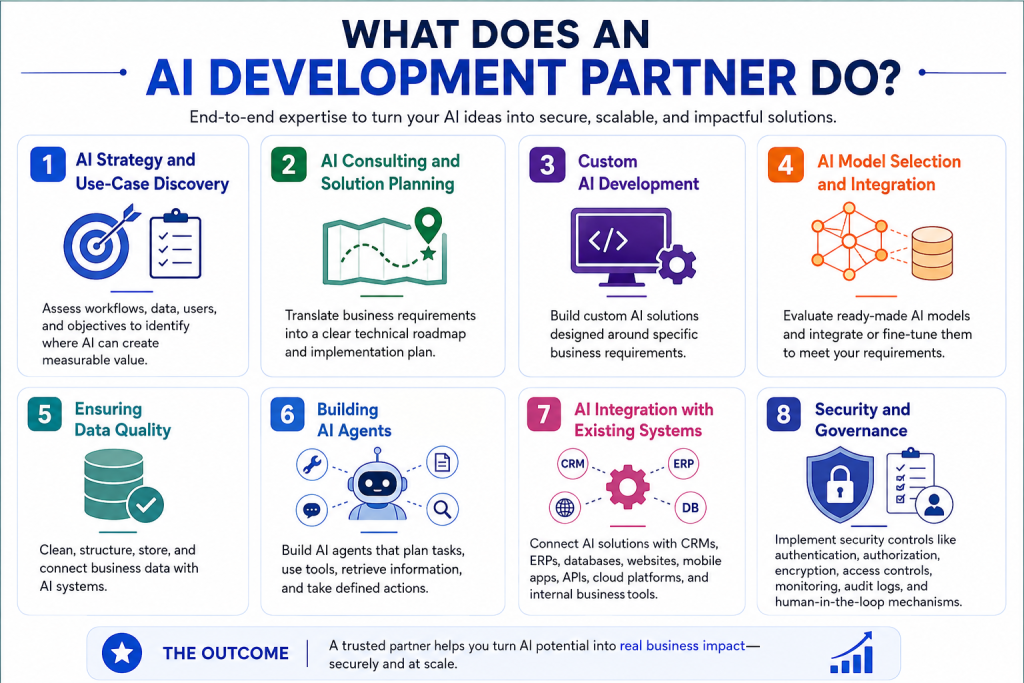
What Does an AI Development Partner Do
Key services offered by an AI development partner
Thus, we can say that they really help teams identify challenges and then use their intelligence to turn them into real-world business opportunities for enterprises.
Key Factors to Consider When Choosing an AI Development Company in the UK
Planning to bring an AI project to life? In this case, your next move should be to connect with an AI expert team like Fluper. So, logically, now you need to evaluate which factors can help you choose the right AI development partner.
That being said, this section will help you explore the aspects you cannot miss out on while making this decision.
1. Check Their AI-Focused Expertise
Start exploring their core technical capabilities. This can include evaluating their case studies, projects, and more.
Most importantly, the right expertise should match your use case or the project you have in mind, whether it is about Generative AI, ML solutions, AR/VR, or other technologies.
2. Review Their Relevant Portfolio
Aligning with the last point we discussed, teams need to check their provider’s portfolio really well. This includes understanding how the partner applies AI to real business projects, which projects they have solved, which technologies they used, and how they implemented them on a practical scale.
Overall, teams can also check the previous project’s scalability and measurable outcomes.
3. Evaluate their Problem-Solving Approach
Another important criterion that can guide your provider’s evaluation is understanding their problem-solving approach. Generally, teams can ask the provider about the following aspects to know this detail:
- AI model selection
- Data preparation
- RAG and knowledge retrieval roadmap
- API and system integration
- AI agent architecture
- Testing and evaluation
- Cloud deployment, and
- Monitoring and optimization
What’s more, this can help provide more clarity on how they plan and apply AI solutions to real business problems.
4. Prioritizing Data Security and Responsible AI practices
Data protection, security, and responsible AI are not an afterthought anymore. In 2026, these are a very critical part of the business discussion as they are included in the development from day one.
That being said, your provider should be an expert at handling security affairs in technology by applying strict authentication, authorization, encryption, and various other protocols. Essentially, these are also mandatory as per the regulatory norms of the UK.
5. Focus on Building Scalable AI Projects
Scalability and post-launch support are two other non-negotiable elements that should be part of your critical evaluation. Your AI partner must be present to manage your app or platform as it grows, and also ensure its long-term maintenance.
Fundamentally, this is important from both perspectives, i.e., the cost and performance viewpoint.
6. Communication
Largely, AI projects involve various important technical and business decisions. So, your provider must be able to share updates with your team frequently, share project status and milestones, and lastly be able to explain complex concepts in an easier language when necessary.
As a result, communication and collaboration are what can help you track your AI project in the long run.
A Leadership Checklist
Simply, here is a list of questions that you need to ask.
- Do they have the expertise to solve our problems?
- Have they handled any similar projects?
- What is their work methodology?
- Can they build solutions with security and governance in mind?
- How will they share regular updates?
Can they show how the investment will create business value?
If the answer is consistently yes, then you can be confident that you have found the tech provider that can partner with you in the long run.
Technologies an AI Development Team Should Know
Modern AI development today relies on various models, data infrastructure, application frameworks, APIs, cloud platforms, security, and monitoring.
Based on this aspect, we can say that teams should have knowledge of these few technologies so that they can easily manage to solve your challenges.
| Technology |
How it adds value |
| Python |
It gives developers an access to a large ecosystem of AI and data libraries. |
| Machine Learning |
This is useful for forecasting,sharing recommendations, fraud detection, and predictive analytics. |
| Large Language Models (LLMs) |
It enables the development of chatbots, copilots, and generative AI applications. |
| Generative AI |
This AI helps businesses with content creation, and managing automated customer interactions. |
| AI Agent Frameworks |
These strategically help support more autonomous AI workflows and complex task execution. |
| APIs & Integrations |
It allows AI systems to integrate and work with CRMs, ERPs, databases, websites, mobile apps, and other internal systems. |
| Cloud Platforms |
This enables AI solutions to be more scalable. |
| MLOps / LLMOps |
It helps teams to maintain AI performance and reliability after deployment. |
| Cybersecurity |
This reduces security risks and also supports teams to enable a more responsible & controlled AI adoption. |
From a broader perspective, the provider should know about the modern technologies that your project would need, and this technical depth is non-negotiable for your future project success.
Cost to Hire an AI Development Company UK
If you plan to hire app developers in the UK, then this section is the right piece of knowledge for you. Well, the cost of hiring a reliable AI development partner in the UK is based on many variable factors. For simpler projects to complex ones, the cost range varies.
That being said, you must have a budget cap in mind for your project already, whether it is a custom AI platform, AI agent development, or building a highly secure enterprise system. So, let us help you understand the average cost range for your project based on the following market-related factors.
In the UK, focused AI integrations can start from around £5,000–£30,000, while production AI features can fall in the budget range of £15,000–£80,000. Additionally, more advanced solutions can move into the £100,000+ range. So, your first question should be understanding the level of project that you want to build to decide its AI development cost.
Next, there are some other cost ranges that you need to know about. These are more descriptively shared in the table below:
| Project Types |
Average Cost Range |
Service Offerings |
| AI Strategy Mapping |
£2,500–£20,000 |
This can include use-case research, technical assessment, AI roadmap, and feasibility analysis. |
| AI Integrations |
£5,000–£30,000 |
It involves connecting existing AI models with websites, apps, APIs, and business tools. |
| AI-Powered Features |
£15,000–£80,000 |
Largely, it includes AI search, sharing recommendations, document processing, assistants, and automation. |
| AI Agent Development |
£20,000–£1,50,000 |
This includes AI agent development, their workflows, integrations, and monitoring. |
| Custom AI Solution |
£50,000–£3,00,000 |
It encompasses custom models, managing proprietary data, and advanced analytics. |
| Enterprise AI Platform |
£100,000–£500,000+ |
It works on large-scale multiple systems, complex integrations, security, governance, and scalability. |
Additionally, there are other costs beyond development that can be counted as ongoing AI costs. These include API usage, cloud, data storage, model optimization, and more. Even your engagement model’s choice can influence your cost sheet. These include hourly-basis pricing, fixed-rate, and project-basis pricing.
So, looking into all these factors and assessing the real value of the project (against its cost) will certainly help your team decide the right AI development partner.
Red Flags to Avoid While Choosing the Right AI Development Partner
Prior to signing your contract or starting development, there are some red flags that you should be aware of. This may be because many companies over-promise and under deliver at times.
So, here is a checklist that can save you from this decision-making trouble:
-
They promise AI results too soon.
Well, the provider needs to put in a lot of time into brainstorming and understanding the business’ goals. So, be cautious if a company does not put in the time to know your business vision, goals, workflows, and users, but still promises results too soon.
-
The partner is not able to explain what technology fits in.
Well, a good partner should be able to explain why a particular technology will fit your use case. Furthermore, check if it’s just buzzwords or if it actually makes technical sense. By focusing on this aspect, the provider’s technical expertise can be really understood.
-
They do not focus on data quality management practices.
Many times, AI systems produce incorrect results because of unstructured data or missing data elements. This is why it’s important for your team to check if the provider focuses on data quality or not. In this case, you can practically enquire about how they measure data accuracy, hallucinations, AI model reliability, latency, and more.
-
They only focus on development costs and don’t discuss ongoing AI costs.
Moving forward, the company’s only concern should not be development costs alone. Discussing ongoing AI costs that may be incurred later is honestly as important. Otherwise, this shows a short sighted project approach from the provider’s end.
-
When security focus is missing in discussions.
Last but not least, security should not be an afterthought. Your provider should focus on how authentication, authorization, encryption, access controls, audit logs, data protection, and monitoring will be placed in the solution from the start itself.
If any of these key aspects is lacking, then it showcases a red flag in the provider’s experience and knowledge, which is something you should look into.
Final Thoughts
Well, choosing an AI development partner is a critical business decision. It not only affects your AI model’s future performance, security, and scalability but also influences its long-term investment. That being said, with the right partner on board, teams get more than just coding skills. They get a partner who can understand their goals and envision their future plan around it.
To evaluate and select the right provider, cost certainly matters. But there are other factors that are also very important. These include AI development expertise, relevant project experience, following strong data practices, focusing on a secure architecture, and a clear direction in terms of testing and AI governance.
So, we recommend that you focus on the following:
- How the provider’s expertise will make your tasks simpler.
- Will your AI projects be more measurable and trackable?
- Will they be more strategic and faster?
- Finally, what is the long-term support you are expecting from the provider?
With these things in mind, leaders should mindfully choose the right partner and proceed with their AI development project in 2026.
 16+ Years of Tech Mastery
Transforming Ideas into Market Ready Platforms |
16+ Years of Tech Mastery
Transforming Ideas into Market Ready Platforms |