Introduction
Imagine a teammate who can work tirelessly and deliver outcomes with perfection without taking any breaks. Well, that is an AI agent for modern businesses in 2026. Simply put, these intelligent systems can think, collaborate, and act independently to deliver outcomes within a specified scope of work.
Elaborating further, a multi-agent AI tool involves many agents working together to handle an entire complex workflow. Thus, we can say that agents are a digital expansion of teams that are redefining how real-time business operations are conducted. Lately, atleast 62% companies around the globe are experimenting with agents and multi-agent AI systems to redefine their operations and improve their growth curve. This is why many leaders are consulting professional AI development experts to build custom multi-agent systems that their enterprise specifically needs.
- Not only can they function on their own, but they can also ensure that decision-making is highly data-driven.
- Additionally, they can even research and analyze data to share valuable insights that can help improve your system’s productivity and output.
Well, it takes a lot of research, technical experience, and calibre to build a reliable multi-agent AI system. With this perspective, this guide covers the entire essence, meaning, functioning, and technical nitty-gritty of a multi-agent AI system so that teams can comprehensively build this project in the modern-day.
What is an Agent?
Before we understand what a multi-agent AI is, let us first clearly explore what an agent is.
Generally, an LLM functions by taking input from the system and producing the expected output. An agent goes further than that. It can reason on its own (based on data files) and act to complete a desired goal. This is mostly a predefined action.
Thus, an agent follows the roadmap:
Observe, then think and act, and then observe again.
This can be better understood through the following example: Suppose a team has a customer support agent. In the most common cases, it can handle customer complaints and raise tickets to get them resolved systematically. That being said, this follows steps like connecting with the customer, understanding their request, guiding them to take certain actions, and, if the query is not resolved, raising a ticket so that the team can connect with the customer to solve their complaints.
How Does an AI Agent System Work?
In totality, an agent works as follows to deliver a pre-defined outcome:
- Understanding: It interacts with the user and understands their input based on its environment, user data, and documentation.
- Reasoning: This is followed by a smart analysis of the information based on which it determines the best approach to achieve a defined goal.
- Planning: Based on this step, the solution is planned in the form of actionable tasks.
- Usage of tools: This tool is also connected with APIs and databases to manage these tasks.
- Taking necessary actions: Now, the tasks can be automatically executed, which may include sharing necessary feedback and recommendations with the users.
- Contextual Interactions: Additionally, this smart tool also derives its output from its memory, earlier-received customer feedback, and previous interactions to improve how it handles tasks.
Thus, an AI agent has a pre-defined set of actions that rely on its memory and previous interactions, which help it offer simple, customer-friendly solutions in real-time.
What is a Multi-Agent System?
As we understand AI agent, the next logical step is exploring where a single agent may fall short, and a company might need to invest in a capable multi-agent system.
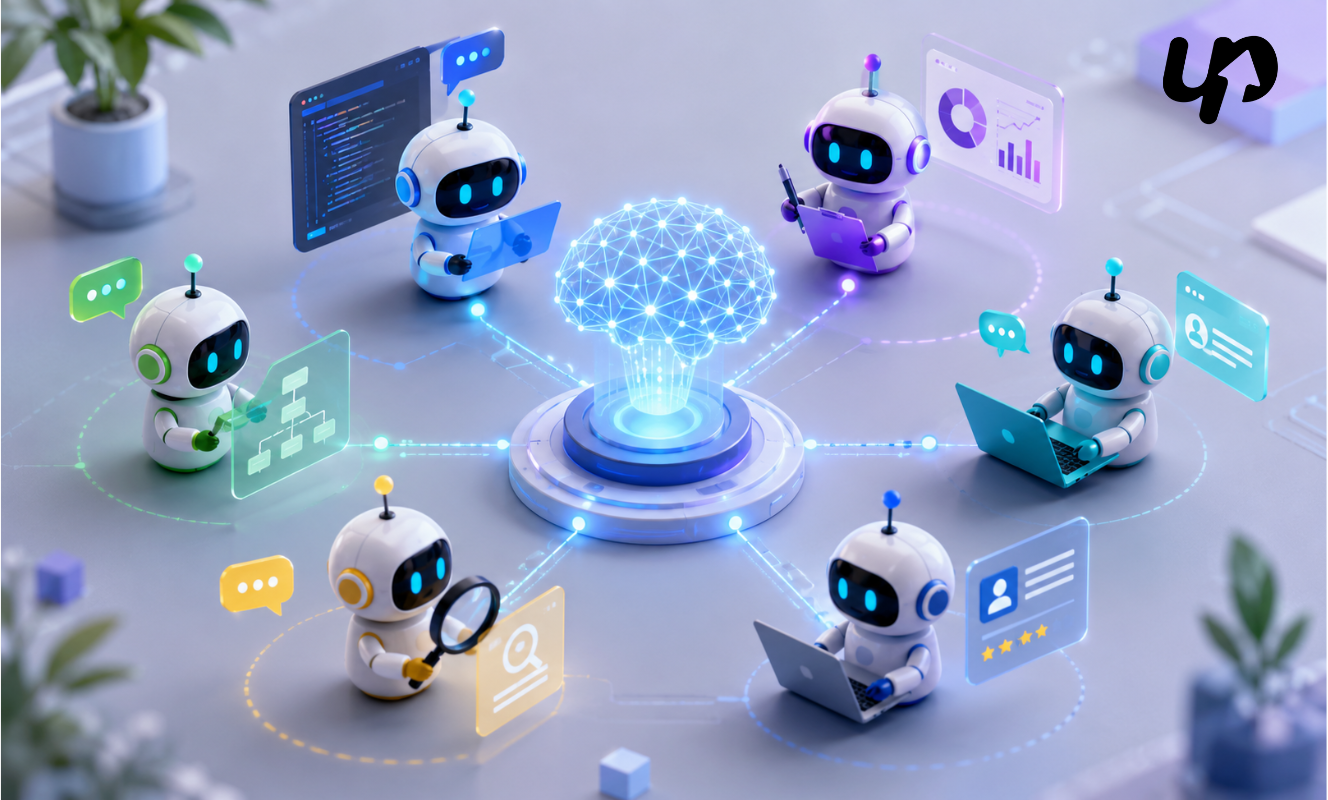
Well, a multi-agent AI system is, of course, the presence of two or more agents that are working together to achieve a set target. This shared goal is generally more complex (than a single agent’s goal). So, in this case, each agent works like a digital teammate handling certain roles, and both of them coordinate to deliver a specific response.
Consider brainstorming an idea with modern AI tools. These systems use multi-agent AI to research, analyze, and put together the right set of workable ideas for creative teams. At times, they may also need to act on their own and share meaningful recommendations (driven by memory). Thus, each agent has a role to play, and this is how this system can help handle more complex workflows that need more reasoning and expertise.
Key Features of a Multi-Agent AI System
Now, let’s zoom in on a well-designed multi-agent system’s features that make it so useful and practical for modern businesses.
These include the following characteristics:
- Specialized agents: In this system, each agent is assigned to perform a specific role.
- Collaboration: Agents also need to communicate with each other and coordinate to achieve a shared goal.
- Task delegation: The tasks are well planned and delegated to the agents in this process.
- Acting Independently: Agents can also make decisions on their own, based on their predefined tasks and scope.
- Shared context: The agents can share relevant information with each other so that the workflow remains contextual as a whole.
Lastly, we can say that agents coordinate with each other and interact with APIs, databases, software applications, and other external tools to perform their defined roles. Moreover, many critical workflows also need additional human oversight and approval at times so that the team can avoid errors in the process.
How Do Multi-Agent AI Agents Really Work?
Now, let us closely understand how a multi-agent system works. This generally includes the following key steps:
* It all starts with a user request. Accordingly, the task is planned in the form of smaller requests that have a pre-defined scope of work.
* As necessary research is done by agents, the data is gathered using APIs and a knowledge base, which then allows for detailed analysis of the issue.
* Further, these insights are checked by a validation agent, while another agent can prepare the final report and share it with the user.
In this manner, these agents work simultaneously to retrieve information and share necessary responses, thereby meeting their desired goal.
Types of Multi-Agent AI Systems
Largely, many brands want to understand the different types of this modern system so that they can categorically define and work on building the right model for their firms.
So, these are the types of multi-agent systems that can be developed by your teams.
- Centralized Multi-Agent Systems
Mainly, a centralized multi-agent tool is one where control is solely with management, and workflows can be assigned and tasks can be coordinated through that approach itself.
Example: A content marketing agent has a centrally controlled framework that can research, write, and edit text to share the desired output.
2. Decentralized Multi-Agent Systems
As the name suggests, in this type of multi-agent system, the agents operate with greater independence, and they can coordinate with each other to respond to dynamic user requests.
Example: Practically, many energy companies plan their resources through this type of model, where they can balance and share resources in real time across different locations.
3. Hierarchical Multi-Agent Systems
This is a system where agents are scattered across different levels. In this model. some agents plan tasks, and other agents are responsible for executing them. Overall, this helps the system manage more complex workflows and decision-making.
Example: A great example of this type of system can be an automated software development workflow where tasks are planned, delegated, and completed by following an elaborate hierarchy.
4. Adversarial Multi-Agent Systems
In this type of multi-agent system, the business can evaluate different proposals, compare them, or help with sharing strategy recommendations based on competitor-based research.
Example: Many cybersecurity teams can design this type of multi-agent system to discover security patches in their systems and strengthen them before an attack happens in real-time.
So, we can say that the right architecture fulfills your workflow’s goals and matches its complexity. Even the level of autonomy and risk is a consideration teams can’t skip in this decision. Furthermore, professionals should plan this build by keeping their goals, scalability, reliability, cost, and performance in mind.
Understanding the Architecture of Multi-Agent AI Systems
In technology, what defines an outcome is how different components are placed together to achieve a goal. That being said, a planned response can be achieved only if these necessary components are part of your multi-agent AI systems.
These are described below:
AI agents are the main working unit of this development. Simply put, here each agent plays a specific role that makes them indispensable too. This can be research, writing content, or handling a specific user query. Specialization also enables agents to perform tasks more accurately.
This acts as the central control of this tool. Simply speaking, this is your team’s digital coordinator. So, it has to do the work of defining each agent’s roles, sequences, and how coordination will be done to achieve a shared goal.
Coming to another important aspect without which this development cannot work, agents have a pre-decided communication layer that they must follow. Through this channel, instructions, requests, and information are shared among the agents.
Memory is what actually allows the agents to retain useful information across tasks. This technically helps them to store previous interactions and results, thereby enabling better decision-making over time.
Now, there is also a shared knowledge base that provides agents with access to reliable data and information. This is the very foundation of how agents retrieve important information to deliver the expected results.
Furthermore, agents also need APIs and tools to connect to external sources like CRMs, databases, payment systems, and more. This allows them to perform actions more accurately, thereby adding value to real-world business situations (within a limited scope).
Security and governance frameworks still need to be defined to ensure that no unauthorized actions take place, and sensitive data is not at risk. This is a legal regulation that teams cannot miss, as agents often deal with highly sensitive data and critical systems.
Finally, automated monitoring is necessary for systems as it helps teams track the agent’s actions, errors, response times, and overall outcomes in real-time.
Overall, these aspects can help build the right foundation for your custom multi-agent AI system in the modern day.
Multi-Agent AI vs. Single-Agent AI: Understanding the Difference
Now that we understand the key architecture of a multi-agent AI system, the next question is pretty simple. Do you need a system with a single agent or a multi-agent one?
This choice can be made by assessing the factors mentioned in the table below:
| Factors |
Single-Agent AI System |
Multi-Agent AI System |
| Architecture |
It uses one agent to complete a task end-to-end. |
This aspect uses two or more AI agents that have defined roles. |
| Task Management |
Since there is only one agent, it handles all the activities in a workflow. |
In this case, a complex task can be categorized into smaller activities and assigned to different agents. |
| Agent Roles |
One agent is responsible for completing all the roles. |
Here, each agent can specialize in a different function. |
| Communication Layers |
This model has limited need for shared communication, as there is only one agent involved. |
Multiple agents need to share important business information to-and-fro through a pre-defined communication layer. |
| Orchestrator |
Overall, a simpler orchestrator can manage all functions done by a single agent. |
A complex orchestrator is required to manage tasks for different agents, while also managing their coordination and control. |
| Tools and APIs |
This model has a limited need for APIs and tools. |
This model has a more diverse need for APIs and tools so that agents can connect to different CRMs, databases, and more. |
| Memory and Context |
The agent’s memory is retained by the application layer, helping it to offer valuable feedback. |
In this case, the memory for various agents can be individual or shared, depending on the model’s goals. |
| Level of Complexity |
Largely, this model is easier to develop, test, and debug for teams. |
This model requires a more diverse and complex architecture, testing, and monitoring. |
| Scalability |
This model enables scaling by allowing a repetitive use of the same agent to achieve like-minded outcomes. |
Here, scaling is possible if more agent roles are added to the system along with enhancing its coordination surface. |
| Performance |
Performance is easier to manage and control. |
This model needs more visibility to ensure desired performance, as many agents are working together to deliver a set outcome. |
| Security and Monitoring |
Fewer access controls and permissions need to be managed in this model. |
To effectively ensure tight-lined security and monitoring, this model needs a higher level of permissions for each agent and tool in use. |
Based on this analysis, we can say that a single-agent AI system is easier to manage and is best suited for tasks involving resolution of customer queries, content management, and basic automation.
On the other hand, what makes a multi-agent AI more valuable is its capability to handle scalable processes, automation, and more adaptive business workflows. Thus, it is more fit to manage complex tasks that can be completed using automation.
Use-Cases of Multi-Agent AI Systems
As we dive deeper into the essence of understanding multi-agent AI systems, our next step in this analysis is understanding the aspects where this technology can practically add value.
That being said, here are some of the key use-cases of multi-agent AI systems for companies:
1. Customer Support: Here, a multi-agent AI system can contribute significantly by understanding a customer’s query, retrieving necessary information, and responding to the request as needed.
2. Market Research: Many companies today use research agents to gather extensive information on a topic. These systems also analyse key industry trends, competitors, and main customer insights. Finally, all this can be placed in an automated, detailed report for the brand’s decision-making support.
3. Sales and Lead Management: Herein, this technology helps teams qualify leads while also personalizing them and sharing follow-up with potential clients. Overall, this can save your sales team’s time and effort in reaching out to people.
4. Financial Analysis: In the finance domain, a multi-agent system can add value by helping the team collect data, analyze trends, and prepare key insights that can be used in reframing business strategies. This can be used by management for critical decision-making.
Likewise, this technology can be highly useful in terms of content creation, software development, and many other business domains today.
Benefits of Multi-Agent AI Systems
Certainly, we know that a reliable multi-agent AI system is capable of managing complex and scalable business workflows. But that statement alone is incomplete.
That being said, this system is capable of a lot more, and some of its key benefits for brands are shared in the section below:
- Higher productivity: Multiple agents can handle different tasks simultaneously. This simply means reduced workload and faster task completion for your diverse teams.
- Smarter task delegation: Each AI agent can be assigned a specific responsibility, and this makes work much easier and faster.
- Faster decision-making: Essentially, agents gather data and also process and analyze it to share relevant business reports and insights with the teams at a faster pace.
- Supports scalability: Furthermore, many IT teams can expand their digital capabilities by investing in more custom multi-agent systems. This can practically help them to enable more streamlined workflows.
- Greater business agility: Overall, multi-agent AI systems can connect with existing tools, data sources, and apps to easily access business data, thereby supporting business workflows.
Overall, AI agents are a great tool to enhance your firm’s productivity and results, and this is why consulting an expert in AI agent development services can help your team develop the custom agents that actually adapt to your business requirements.
Challenges and Limitations of Multi-Agent AI Systems
Well, building a reliable custom multi-agent AI solution is not all. There are certain challenges that professionals need to overcome to derive desirable results.
Some of these are descriptively shared in the table below:
| Challenges |
Description |
Their Practical Solutions |
| Complexity in Design |
Working with a multi-agent system is complex due to its design and architecture. Even its maintenance can require a higher amount of manual effort. |
Setting a clear technical foundation is necessary. The first step should be identifying each agent’s role and understanding how they will integrate with each other to deliver results. |
| Duplication of Tasks |
Sometimes, agents may duplicate tasks or lack proper interaction with each other, which can affect the output. |
The right approach is using clear communication protocols and enabling smarter task delegation rules to coordinate agent activities better. |
| Data Quality Concerns |
Another key challenge is having data quality gaps that can affect your agent’s outcomes. |
To overcome this issue, teams can establish stronger data pipelines and validation processes in their models. |
| Security Risks |
Agents always have to access sensitive business data to respond to user requests, and this gap poses a security challenge for the companies. |
Applying strict authentication, encryption, and access controls and taking governance seriously is necessary to avoid this critical risk. |
Overall, what matters is governance and how the multi-agent AI model is engineered, as this can help avoid many risks from day one, thereby ensuring that the business gets its desired results.
How to Build a Multi-Agent AI System from Scratch?
As leaders understand the benefits and challenges of working with a multi-agent AI system, the next step in our research is discovering how to build one from scratch.
From architecture to design, a successful system needs a lot of planning. So, let us more clearly understand how to build a multi-agent system in terms of its engineering.
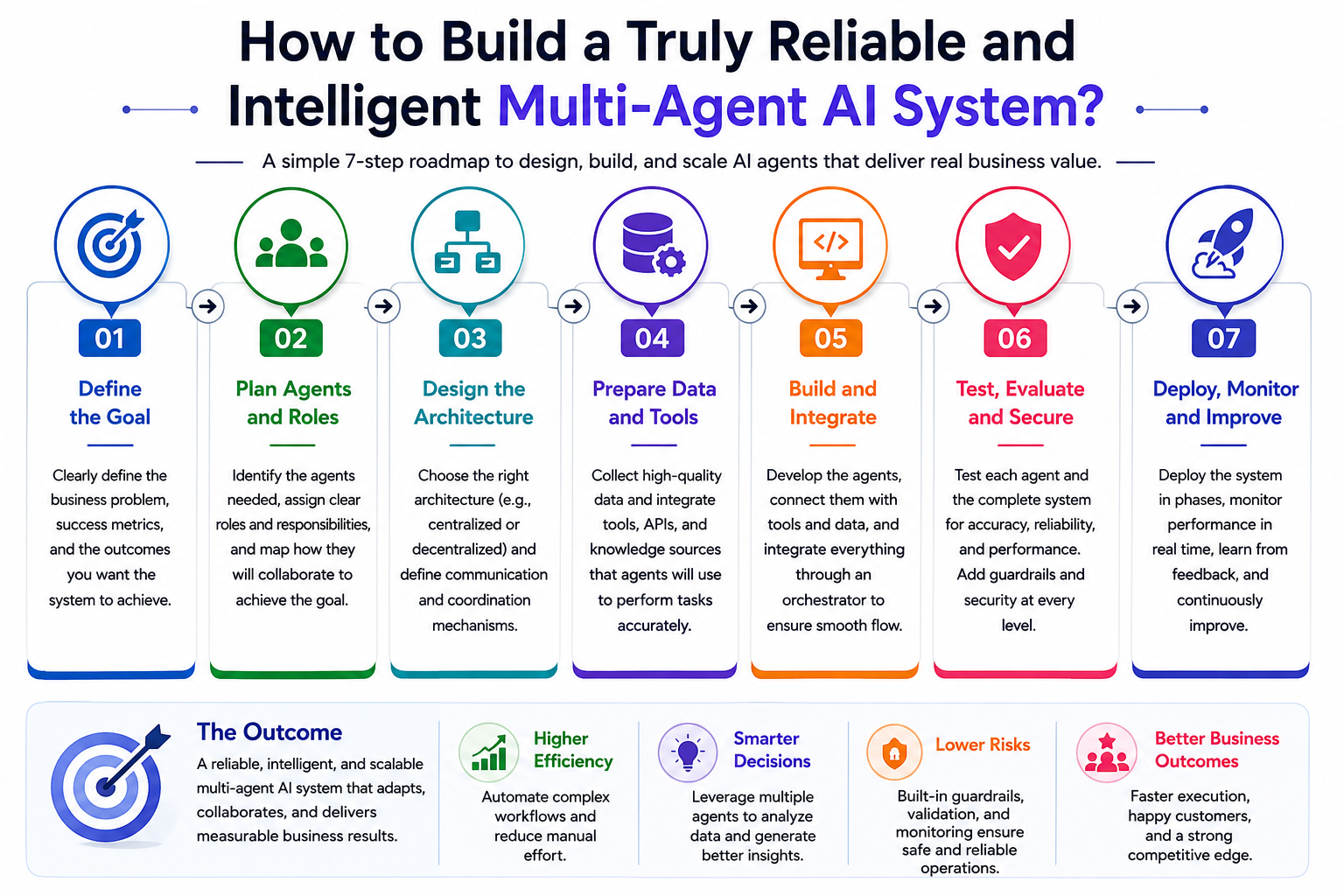
Build a Multi-Agent AI System
7 Step Roadmap to Building a Multi-Agent AI System
Overall, this will help your engineering team understand how this development can be planned and rightly implemented, to deliver the results that they expect in the long run. In this case, teams can also consult AI development experts to build the right agent systems for their enterprise. Their guidance, goal mapping, and support can make an immense difference to what the model turns out to be.
Tech Stack of a Multi Agent AI System
For leaders, the development process is not about exploring a few countable steps. It involves extensive planning, selecting the tech stack, and understanding what the model should cost. So, for management, once this process is clear, the next move in this project is choosing the right technology stack for the multi-agent AI system.
Largely, this includes selecting the AI model, framework, orchestration, data infrastructure, and more elements and putting them together to allow the desired functionality. That being said, here is a table sharing which tech stack you can choose for your system to build it correctly.
| Technology Layer |
Description |
Common Technologies |
| LLM Layer |
Allows reasoning and decision-making |
OpenAI, Google Gemini, open-source LLMs |
| Frameworks |
Helps developers to create agents, tools and memory |
LangGraph, Microsoft Agent Framework, CrewAI |
| Orchestration Layer |
Enables coordination and delegation among agents |
LangGraph, Microsoft Agent Framework, custom orchestration |
| Memory and Knowledge |
Stores data and previous conversations to provide context |
PostgreSQL, Redis, vector databases, knowledge bases |
| Data Layer |
Connects the agents with business data sources |
RAG pipelines, embeddings, vector search, data APIs |
| Tools and Integrations |
Allows agents to interact and connect with external systems |
REST APIs, webhooks, databases, CRM, ERP, cloud services |
| Security & Governance |
Protects data from cyber risks and controls what agents can access |
Enforcing IAM, encryption, authentication, authorization, audit logs |
Well, this table does share a detailed record of the tools and frameworks for custom multi-agent AI model development, but it is still very important for leaders to note that choosing a popular tool is not all. Rather than that, your team should choose the frameworks that align with your business goals, scalability, security, and long-term strategies, as it can help you acheive better results.
The Cost of Developing a Multi-Agent AI System
As teams explore each detail related to the development of a multi-agent AI system, the real question boils down to its cost considerations. Largely, this depends on many variable factors, including the number of agents you need in your system, their complexity, security, and much more.
So, here is a simple cost overview that will help your team estimate the cost of developing a custom multi-agent AI system.
| Projects |
Average Cost Range |
Scope of Work |
| Simple Proof of Concept |
$15,000-$30,000 |
Developing basic agents that have limited workflows |
| MVP Development |
$30,000-$75,000 |
Working with multiple specialized agents, APIs, memory, and testing |
| Fully Ready System |
$75,000-$1,50,000 |
Including advanced workflows, infrastructure, security, and monitoring |
| Enterprise-level System |
$1,50,000-$4,00,000+ |
Managing complex workflows, security, governance, and integrations |
Overall, we can say that every IT specification adds cost to your project. So, specify the scope and then plan how the custom multi-agent AI model should be built. Furthermore, teams can also start with an MVP-based approach (having a lower cost range), and then scale up based on their business requirements.
Final Thoughts
Working on AI models’ development today requires immense focus and a 3D dimensional viewpoint. Every brainstorming session and team meeting can be messy with too many development directions, ideas, and workable recommendations.
But what will help you focus on the right model will be how you navigate through these choices. Additionally, taking guidance from management and discussing the alternatives with a third-party AI developer can also help provide technical clarity. Overall, this will help your teams choose the right architecture, tools, design, integrations, and much more.
Wrapping up, we can say that the team’s ultimate goal should not be building a complex project. It actually is building something that will make your tasks more manageable, while focusing on security, governance, and automated monitoring. That’s where you can start building real value in terms of this project.
 16+ Years of Tech Mastery
Transforming Ideas into Market Ready Platforms |
16+ Years of Tech Mastery
Transforming Ideas into Market Ready Platforms |