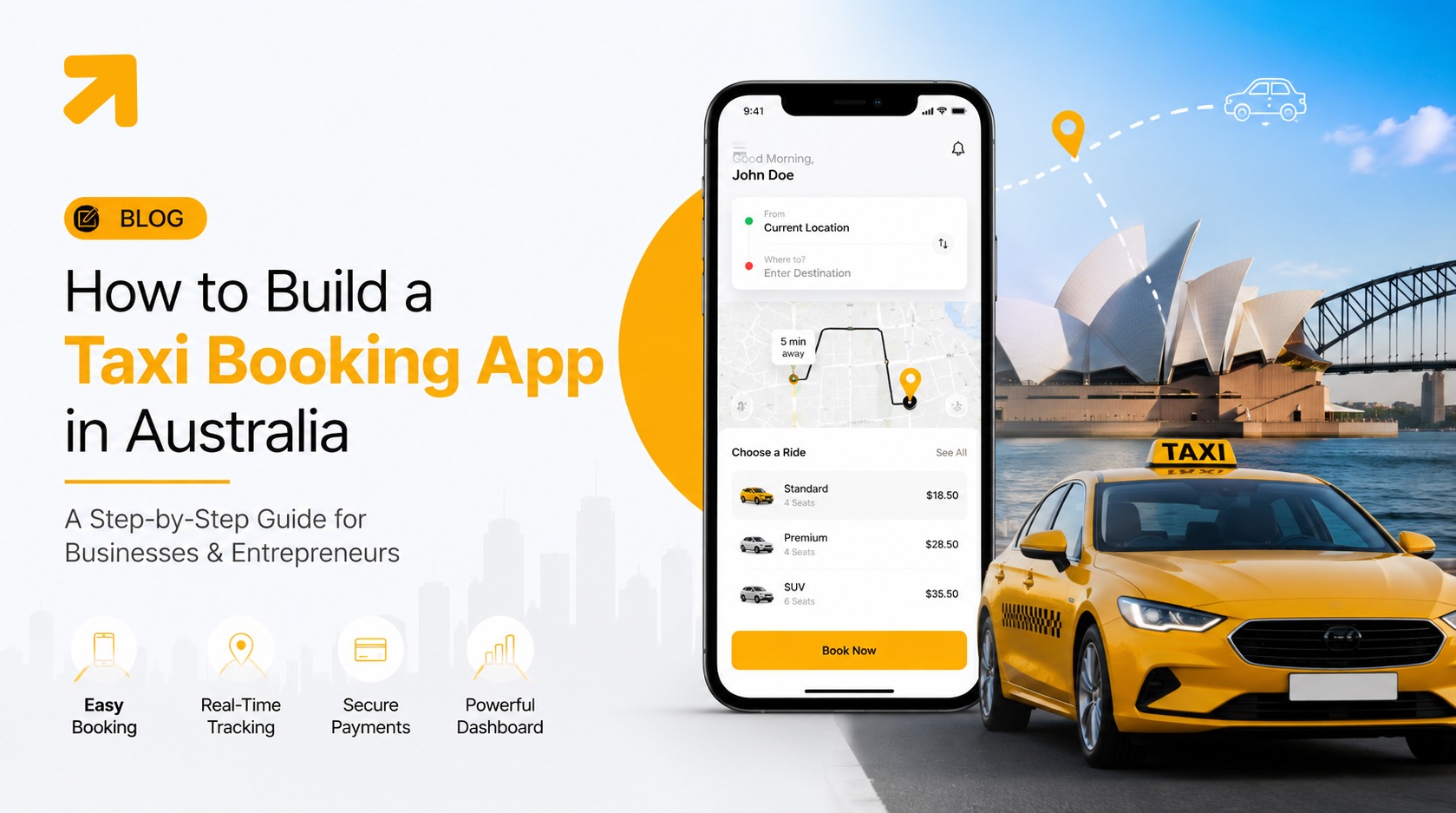
In Australia the ride-hailing market is hyper-competitive, fast-moving and whilst Uber may dominate news coverage, it’s a market with a far more complex picture than that single name suggests. DiDi has a huge chunk of the market in Sydney, Melbourne and Brisbane, Ola has a loyal customer base in several cities, and local players like 13cabs are holding their ground especially where reliable services, corporate and airport services, trump cost.
For any startup, fleet operator, transport business or investor aiming to launch a taxi booking app in Australia then 2026 offers a real window of opportunity. This guide takes you through every step of getting your concept through to a viable, competitive product.
Market Overview- Ride-Hailing in Australia 2026
Over the past ten years ride sharing and taxi services have undergone tremendous structural shifts in Australia and these are ongoing. The addressable market in these services is in the billions of dollars per year and is primarily driven by increased urban density, young Australians forsaking private vehicle ownership and the adoption of ride-hailing as a travel management tool for corporate clients.
For 2026 the market is driven by two significant trends:-
Firstly the regulatory landscape in Australia continues to change, with distinct licensing and compliance criteria for each market – the biggest of these being inNew South Wales, Victoria, and Queensland. A taxi app developer that plans to succeed in Australia, must design regulation into the product, not consider it a secondary factor.
Secondly there is a widening price gap between premium and value ride-hailing which could represent a significant opportunity. Corporates in particular are seeking travel solutions other than their current big ride-hailing brands. These users are looking for services and features more suited to them such as superior invoicing and account management tools.
Why Build a Taxi Booking App in Australia Right Now?
There are many convergent trends making Australia the place to be for the development of a taxi booking app right now in 2026. These large ride-hailing brands are well known but their customers are increasingly frustrated with price surge, service consistency and customer support when unexpected situations arise. This willingness to look for and switch providers is what any potential competitor needs to capitalise on.
Even the underlying technologies required to build such an app are much more accessible now than ever before. Cloud hosting, mapping API’s and cross platform mobile development tools have become significantly cheaper relative to their capability thereby closing the gap in what a startup with sufficient funding can produce compared with a well-established international brand.
Key Features Your Taxi Booking App Must Have
To stand out from the crowd and meet established standards in the Australian market, you’ll need a suite of features built into your product from launch, and failing to do so may hinder long-term growth.
1. Real-time GPS Tracking
Visibility needs to be granted on both sides; drivers need the capacity to share their location, navigate to the passenger and plan routes in real time. Passengers need the ability to see where their car is throughout their ride. To accommodate Australia’s diverse terrain a comprehensive, local mapping layer will be essential, such as the Google Maps API or equivalent with detailed Australian information.
2. Instant and Scheduled Bookings
Booking a ride on demand is the standard in most of the world now, but the capability to book a ride in advance (for a scheduled airport pickup, an early morning medical appointment or an evening out) represents a sizable segment, especially where corporate clients are involved. Include both in the initial product offering.
3. Multi-payment Options
Most Australian customers will expect to be able to pay with their debit/credit cards, digital wallets (Google Pay, Apple Pay) and their own in-app stored method of payment. Corporate clients will need the ability to invoice centrally and manage business spending through an established account. Having these options available to all users from day one is paramount.
Advanced Features that Elevate an App
1. Corporate Accounts and Management
Corporate clients are a segment that value having the ability to integrate ride bookings into a central business application. Having this as part of your offering will give them a corporate dashboard where they can manage individual employee spend and approve journeys along with centralized invoicing. A corporation is going to be a steady, high volume user who would be unlikely to switch.
2. Disabled Vehicle Options
The needs of Australia’s disabled population mean that providing a market specifically catering for wheelchair accessible and other disability suited vehicles fills a niche that is currently not addressed in the major players’ services, akin to the approach taken by 13cabs.
3. Driver Earnings Dashboard
Retention is critical in two-sided marketplaces. An intuitive driver-facing application providing clear information on earnings, rides completed, performance, and support features is crucial for keeping drivers happy and the service level high.
Technology Stack to build a taxi booking application in Australia
For developing taxi booking applications, the primary requirement is a solid base technology stack that is used for running the application. It is required that it be a system that could efficiently handle millions of real time location updates, could handle payment transactions securely, could easily solve the two-sided matching problem and provide a rich user experience during rush hours such as weekends and events.
A good technology stack for such applications include a framework for mobile application development such as React Native or Flutter, both of which have a single codebase to develop on iOS and Android without compromising on performance. For back end application development, a stack such as microservices based Node.js would be useful. This allows the scaling of features such as ride management, payments processing, ride notifications to drivers, etc. In a modular way depending on the load and demand.
For maps and navigation purposes, Google Maps Platform or Mapbox is a good choice for use in Australia as it covers the entire continent and has accurate maps.
Cost of Developing a Taxi App
Cost to develop a taxi application in Australia will primarily depend on the features included in the application as well as whether the application is developed locally or overseas. It is expected that development of a basic version of the taxi app will involve some booking functionality, tracking and a payment gateway.
The cost of developing a minimum viable product (MVP) of a taxi application is expected to range between AUD50,000 and AUD100,000 and should be developed within 3-5 months. The minimum viable product is considered to be the base requirement for launching a new taxi application to establish the product-market fit and gain traction within the existing market and then iteratively add features based on customer demand.
An extensively developed and market competitive taxi application similar to popular ride sharing applications would be developed between AUD300,000 and above and will take anywhere between 10-14 months of development. This would also include features such as ride pooling, driver incentives, detailed reports, multiple payment gateways, etc. Costs to run the business will include cloud hosting, updates and maintenance of the application. Initial monthly running cost is expected to range between AUD5,000 – AUD15,000 depending on the system load.
Steps for Developing a Taxi Booking App
Building a taxi application essentially follows the same development process whether it is simple or highly advanced. If any of these steps are skipped, there may be future expenses that arise.
- Initial Market and User Discovery-
It should involve identification of target users, the target geography and differentiation between products. Trying to beat established products in every category would probably be more difficult compared to targeting niche users such as business travelers or local transit travelers or those with accessibility issues.
- UX and Prototyping- They must be considered before writing code. Basic user flow for booking a taxi and a communication channel between customer and driver needs to be established and defined. A sprint development process over two weeks would be required while trying to ensure iterative modifications at every step. Driver and passenger testing with a small group of users is expected to be up to one month before public release of the application to rectify any issues and optimize system performance.
Incorporation of legalities from the beginning of the development process are also important; all required licenses for ride-hailing, driver verification processes and data protection policies stipulated in the Australian Privacy Act need to be accounted for from day one.
The Benefits of Working With Fluper, an Australian Mobile App Development Company
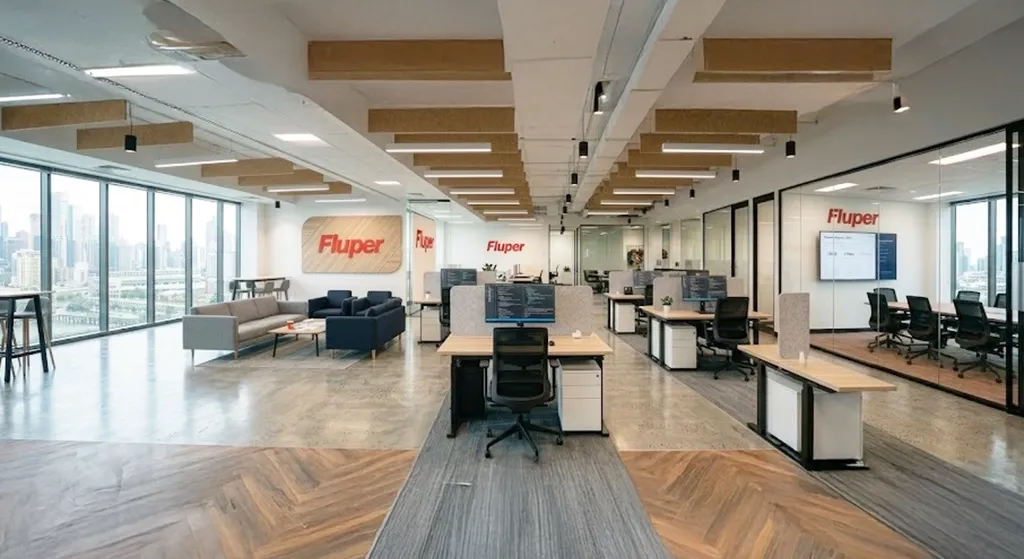
One of the biggest advantages of partnering with Fluper Australia for mobile app development is access to a team that understands the Australian market, user expectations, and business landscape. Unlike many offshore companies, Fluper offers seamless communication across compatible time zones, ensuring faster collaboration, transparent project updates, and efficient support throughout the development process
What experience the mobile app development company in Australia have when it comes to the development of a taxi booking application of such complex nature is a key element, in the case of the product, if a firm has experience in other two sided market applications, products associated with mapping and transport, logistics should strongly be preferred over other agencies that have no prior experience in such niche.
An integral part of the discussion is about post launch support, a crash in your taxi booking application at a busy hour or at a weekend would lead to substantial business loss and negative brand identity and so it is imperative that the mobile app development company of choice have a clear process for any such breakdowns occurring instantly.
Frequently Asked Questions
Q1. What is the typical time required for taxi booking app development in Australia?
MVP would take between 3-5 months, whereas a medium complexity app would include features like corporate booking capabilities, user accessibility and it would take anywhere between 6-9 months to develop. A highly sophisticated and feature rich application similar to existing leaders could be expected to be developed in anywhere between 10-14 months, starting from discovery, specification stage and ending in launch.
Q2. Is a permit required to run a ride-hailing app in Australia?
Yes, you are required to comply with the state regulations relevant to transportation if you plan to launch a ride-hailing or taxi booking application in Australia. These laws vary quite a bit state-wise. New South Wales, Victoria and Queensland require you to consult their respective state’s legislation which can be found at transport.nsw.gov.au, vicroads.vic.gov.au and tmr.qld.gov.au respectively.
Q3. Can a smaller player build an app like 13cabs?
Yes, the task of building an app like 13cabs is absolutely possible. However, one should have reasonable expectations on scale. Developing an app like 13cabs with all its features at once is either unrealistic or often not at all necessary for a startup. A smaller MVP focused application targeting a certain region or population group would be a more viable strategy to ensure smooth growth.
Q4. What is the one most critical feature for a taxi app launch?
Driver matching, ride tracing features are key here. The long time taken to select a driver and the unreliable nature of the tracing facility can deter the user away. So the emphasis for this part needs to be greater.
Q5. How do taxi booking apps make money in Australia?
The commission for each trip is anywhere between 10-25% based on the tier and it could even go higher than that based on certain conditions. Corporate account fees are another source of income as well as Surge Pricing during peak hours. Apart from those, the operators can earn through advertisements of complementary services. Some operators do have a weekly/monthly fee as well which is applied on the drivers.
 16+ Years of Tech Mastery
Transforming Ideas into Market Ready Platforms |
16+ Years of Tech Mastery
Transforming Ideas into Market Ready Platforms |