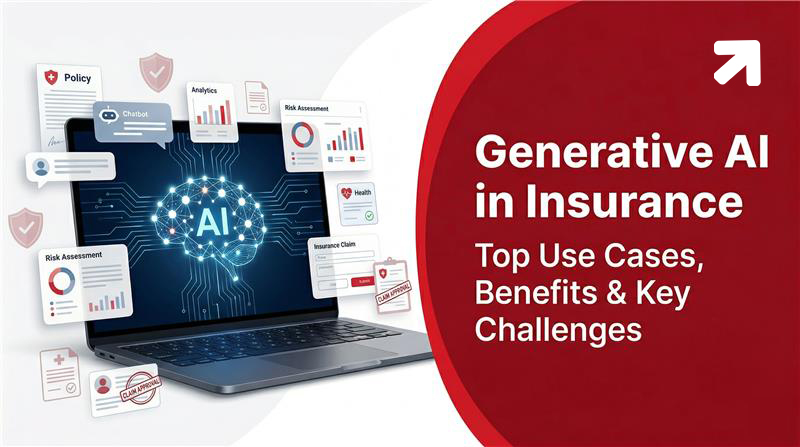
Generative AI in insurance is changing the way companies process complex data and make decisions. Consider a commercial property insurer being presented with a 200-page file of loss runs, inspection reports, policy information and engineering data. A junior underwriter would take two days to go through it a decade ago. Now, a generative AI system can process it in minutes, cross-verify inconsistencies, identify contradictions, and provide a structured risk summary before the underwriter finishes his or her coffee.
This is not a far-off scenario. In 2024, insurance spending on generative AI increased by 357%, showing a clear shift from experimentation to real-world adoption. This article discusses the areas where gen AI can provide value, the quantifiable value it can bring, the most important risks to take into account, and the ways to develop effective solutions.
What Is Generative AI in Insurance and How Does It Differ from Standard AI?
Generative AI is a form of artificial intelligence that generates content like summaries, recommendations, and decisions based on unstructured data, not just classifying inputs. This is a significant change in the processing and use of data in insurance.
Key differences between traditional AI and generative AI:
- Output type: Traditional AI gives scores or classifications, whereas generative AI generates detailed summaries and insights.
- Data processing: Traditional AI processes structured data, but generative AI processes large amounts of unstructured data such as documents and emails.
- Decision support: Generative AI is not only able to predict but explain policies, point out exceptions, and respond to complex queries.
As an illustration, a conventional model can give a claim a fraud score of 0.73. Conversely, generative AI is able to read a 50-page policy document, create a concise summary, compare it to standard policies, and give actionable insights. This is why gen AI is rapidly gaining momentum in the insurance industry. In 2025, the AI insurance market had reached 10.24 billion, with a CAGR of 32.8%.
Why Insurance Is One of the Best Industries for Generative AI Adoption
Why insurance, specifically? The solution is in document overload. The industry processes a greater number of documents per transaction than nearly any other industry. One commercial property submission may contain more than 200 pages of reports, policy wordings and assessments. The process is time-consuming and complicated because underwriters can go through 30-50 such files per week. This is where generative AI creates value. It is able to read, analyze and summarize large amounts of unstructured data in a short period of time, minimizing manual work and errors.
Almost 90% of insurers today are considering AI tools and more than half have already adopted them. Most claim to process up to 75% faster and have better accuracy. It is understandable why this technology is being quickly embraced by insurers with projected cost savings. This fast change underscores the increased significance of gen AI in insurance.
Top Generative AI Use Cases in Insurance
These Generative AI use cases show how insurers are improving efficiency, accuracy, and customer experience.
1. Automated Claims Processing
Claims processing manually is time-consuming, costly and prone to errors. Generative AI accelerates this process by reading documents, verifying policy information, and detecting problems, cutting the processing time by up to 65%. It also creates clear explanations for customers.
For example, Allstate uses AI to handle 50,000 daily messages, improving communication and saving costs. This is one of the most common applications of insurance generative AI today.
2. Intelligent Underwriting Support
Generative AI enhances underwriting by examining policy documents, medical histories, and third-party information to detect concealed risks and draft decisions. McKinsey claims that it can cut decision time by up to 70 percent and allow same-day policies. Many insurers now process applications in hours, with some reporting up to 90% faster underwriting decisions.
3. Fraud Detection and Prevention
Insurance fraud costs about $80 billion annually. Generative AI helps detect fraud with 93% accuracy by finding inconsistencies in claims data. ClaimsGenAI by Swiss Re has already produced fraud alerts in the first year, and Shift Technology has detected more fraudulent claims with AI-based detection systems. These results highlight the combination of generative AI and insurance.
4. Personalized Policy Advice and Dynamic Pricing.
Generative AI uses customer data, lifestyle, and life stages to provide individual policy recommendations and detect product gaps. It also allows dynamic pricing based on telematics, wearables, and IoT data. This creates real-time, behaviour-based premiums, reduces operating costs by up to 40%, and supports usage-based insurance models.
5. Customer Service and Conversational Assistants
Early users of AI in customer support find retention up 14%, and NPS improves by 48% this means users are both loyal and twice as likely to recommend their insurer. The bots answer tough questions all day long – no breaks, no delays. Zurich Insurance’s Voice IQ analyzes customer calls in real time, helping achieve an improvement in retention.
6. Regulatory Compliance and Document Generation
Insurance regulatory documentation is thick, redundant, and time-sensitive. Structured inputs can be used to generate compliance reports, audit summaries, and policy disclosures using generative AI, which saves time and minimizes the possibility of legal review and human error. This is one area that most competitor articles skip over, but it’s where mid-sized insurers are seeing some of the fastest payback periods.
How Does Generative AI for Insurance Work? (Step-by-Step)
Many people think implementing generative AI for insurance is easy, but it actually follows a structured process. To build generative AI solutions, companies need a clear and well-planned approach.
1. Data Collection & Preparation
The insurance companies gather information on policy documents, claims records, emails, and customer interactions. This information is usually unstructured and inconsistent data; it must be cleaned, structured, and formatted in a proper way before it can be utilized by AI.
2. Model Selection & Training
Firms pick AI tools like GPT-based systems and teach them with real insurance data. The system learns jargon, rules, and daily operations through practice.
3. Integration with Existing Systems
The AI is then connected to existing systems like CRM, claims platforms, and underwriting tools so it can work within daily operations.
4. Real-Time Processing
Once live, the AI starts generating outputs such as claim summaries, risk insights, and customer responses instantly.
5. Continuous Learning
The system improves over time through learning new data, user feedback, and corrections.
This is a systematic way of making sure that the AI system is effective and provides real business value. This is why many businesses rely on expert AI development services for insurance.
Comparison: Traditional vs AI in Insurance (Benefits and Limitations)
The numbers in this table aren’t aspirational; they reflect documented outcomes from deployed systems at carriers including Allianz, Swiss Re, and Zurich.
| Process Area |
Traditional Approach |
Gen AI-Augmented Approach |
Improvement |
| Claims processing |
5-30 days, manual document review |
Hours to days, automated extraction and routing |
Up to 65% faster settlement |
| Underwriting decisions |
3-7 days, manual risk review |
Same-day decisions, AI-drafted summaries |
Up to 90% faster turnaround |
| Fraud detection |
Rule-based, high false-positive rate |
Pattern-based anomaly detection across unstructured data |
93% accuracy in inconsistency detection |
| Customer queries |
Call centre, 9-5 availability |
24/7 AI assistant, instant policy lookup |
20-40% reduction in service costs |
| Compliance reporting |
Manual drafting, legal review cycles |
Automated generation from structured inputs |
30-50% reduction in admin burden |
Real-World Example of Generative AI: Improving Claims Accuracy and Speed
Take the example of a medium-sized property and casualty insurer that handles approximately 2,000 claims monthly. Before the implementation of AI, adjusters took almost four hours per claim to review photos, repair estimates, and policy terms by hand, and rule-based fraud detection only identified blatant problems.
Following the introduction of a generative AI solution that was trained on five years of claims data:
- Less time to review: The average per-claim review time decreased to less than 40 minutes.
- Improved fraud detection: The system identified 18 percent more suspicious claims during the first quarter than the rule-based system.
- Improved customer satisfaction: Scores increased by 22% due to faster and clearer AI-generated communication.
Major Challenges of Gen AI in Insurance You Must Know
While generative AI and insurance offer strong benefits, they also come with important challenges:
- Data Quality and Legacy Systems.
Most insurers operate on old systems with disorganized, fragmented and isolated data. This complicates the provision of correct results by AI and slows down implementation.
- Regulatory and Explainability Requirements.
Decisions on insurance should be transparent. The AI models should be able to articulate the decision-making process to ensure that the decisions are made in accordance with strict regulatory requirements.
- Risks of Accuracy and Hallucination.
In some cases, generative AI may give wrong or inaccurate results. This may have severe legal and financial implications in the insurance industry and thus human review is necessary.
- Bias in Risk Assessment
The AI models that are trained on past data can be biased. Regular audits should be carried out to enable the making of unbiased and impartial decisions.
- Data Security and Privacy.
The insurance companies deal with sensitive customer information. The AI systems should adhere to the stringent data protection regulations and secure data processing at any given time. These risks are important to manage to scale insurance generative AI successfully.
Choosing the Right Generative AI Development Partner for Insurance
To create effective insurance solutions, it is crucial to choose the appropriate generative AI development company. It involves more than technical expertise, as partners need to know how to work with complex data systems, regulatory needs, and how to integrate smoothly with existing platforms. A powerful team will have practical experience with AI technologies, be able to work effectively with legacy systems, and be familiar with actual insurance processes such as claims and underwriting.
In addition to this, model development and API integration to UI/UX and security end-to-end knowledge is essential to scalability. This is where dedicated AI development services to insurance come into play. Reliability and compliance assurance are also provided by global experience and certifications. Above all, companies are advised to concentrate on bespoke AI solutions that suit their requirements, instead of using generic, one-size-fits-all solutions.
Why Fluper is Your Generative AI Development Company of Choice in Insurance
The selection of the appropriate generative AI development company can have a considerable impact on the success of your insurance solution. Fluper has a solid experience in the development of AI-based systems that are specific to complicated insurance processes, such as claims, underwriting, and fraud detection. The team has extensive experience in managing large volumes of data, integrating legacy systems, and regulatory needs, which will facilitate a smooth and compliant implementation.
Fluper specializes in providing end-to-end solutions, including model development and API integration, to user-friendly UI/UX and secure architecture. Their strategy focuses on customization, where each solution is tailored to meet the particular business requirements and not generic models.
With a team of experts and experience in global projects, Fluper assists insurers in creating scalable, efficient, and future-ready generative AI solutions.
Conclusion
Generative AI in insurance is not a concept of the future it is already changing the way insurers do business. As many companies consider or implement it and the market is projected to grow significantly and reach 88 billion in 2030, speed and competitive advantage are now in the spotlight. The advantages are obvious: the acceleration of claims processing, the enhancement of fraud detection, the increase of underwriting accuracy, and customer experience.
Nevertheless, such issues as legacy systems, data quality, and regulatory compliance are to be carefully planned. Insurers require the appropriate strategy, robust data basis, and expert partners to develop scalable, secure, and compliant AI solutions that meet actual business requirements to succeed.
FAQs
- What is generative AI in insurance and how is it different than regular AI?
Generative AI has the capability to generate summaries, recommendations, risk insights, and responses based on unstructured data such as documents and emails. The traditional AI is primarily applied to structured data and offers scores or classifications. Generative AI is unique in the insurance industry as it is able to read, comprehend, and reason long and complex documents.
2. What insurance processes are most beneficial in the short term?
The fastest ROI is provided by claims processing, fraud detection, and underwriting because of the large amount of data and repetitive work. Automation of customer service is also increasing at a rapid rate, as it enhances customer satisfaction and response time.
3. How can companies avoid compliance issues?
Begin with appropriate regulatory mapping, make AI decisions explainable, and have human review of high-risk outputs. It is necessary to collaborate with seasoned data privacy partners.
4. How much does it cost to construct a solution?
Prices are dependent on scope and complexity. MVPs can be completed in 3-4 months, whereas enterprise-level systems have longer schedules.
5. Can it be trusted to make important decisions?
It is reliable in analysis and writing, but final decisions must be made by humans.
 16+ Years of Tech Mastery
Transforming Ideas into Market Ready Platforms |
16+ Years of Tech Mastery
Transforming Ideas into Market Ready Platforms |