The biggest problem that I encountered when I first sat down with a mid-sized automotive client last year was not the construction of cars but the ability to keep up with the pace of innovation.
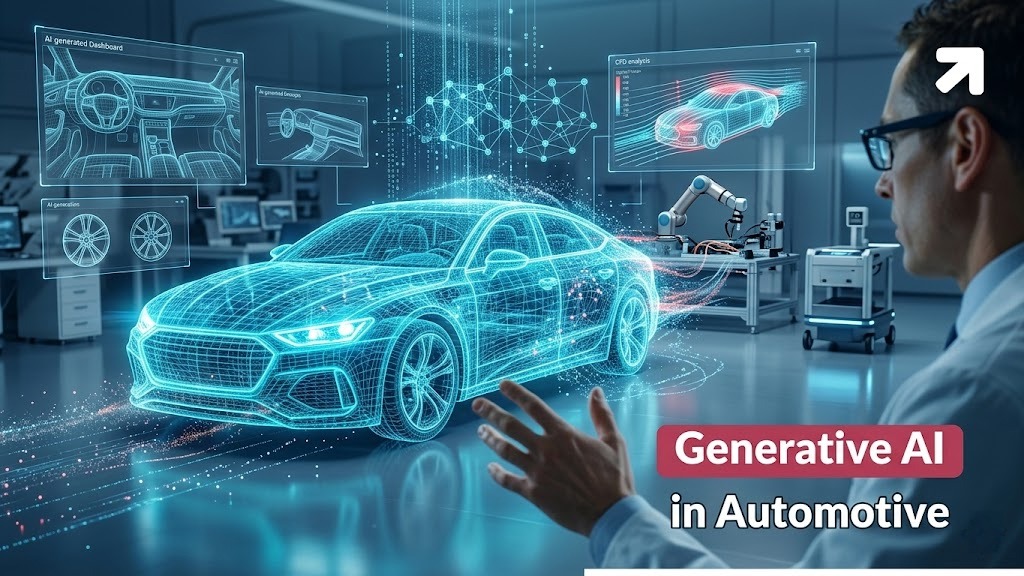
Generative AI in automotive industry is no longer a speculative future technology; it’s transforming how vehicles are being designed, made, and sold.
The application of generative AI is expected to deliver $300 billion to $400 billion annual benefit across the automotive industry in 2035, according to McKinsey (2023).
So in this blog, we’ll dive a little deeper into how auto manufacturers are using this technology, what benefits they’re getting out of it, and a few things to consider if you’re thinking about AI solutions development.
What Is Generative AI in Automotive Industry?
In the automotive sector, generative AI is applied to generate new content, simulate environments, generate code, and design vehicle parts using advanced models such as large language models (LLMs), diffusion models, and multimodal systems. In contrast to conventional AI, which merely analyses or predicts using existing data, generative AI generates completely new content, like a design concept of a vehicle, synthetic training data to drive autonomous systems, or a personalised in-car experience.
This change is significant to automotive companies since the technology not only assists engineers but also actively creates, tests, and optimises solutions in design, manufacturing, safety, and customer experience. It accelerates innovation and minimises manual work.
Moreover, it is not really one single tool but rather a combination of technologies, such as GANs, transformer-based models and variational autoencoders. They have a wide range of uses, for example, creating lifelike situations and designing 3D models. Generative AI is a versatile and highly capable solution in the whole automotive ecosystem.
The figures are eloquent. The worldwide market of generative AI in automotive industry was estimated to be approximately USD 480 million in 2024 and is projected to be USD 3.9 billion in 2034 with a CAGR of 23.30. This rate of growth does not normally occur unless something fundamental is being altered and that is what we are witnessing throughout the industry.
Here’s where most organisations get it wrong. They view generative AI as one of the functions, possibly a chatbot or a styling tool. The thing is that the change is taking place across the value chain. This is being done to design, manufacturing, software development, and customer experience.
This change is even more pronounced in the new developments. In 2025, Mercedes-Benz further collaborated with Google to improve in-car AI experiences. About the same period, Stellantis collaborated with Mistral AI to incorporate AI into engineering and vehicle systems demonstrating this is much deeper than superficial innovation.
How Are Automotive Companies Using Generative AI Today?
The brief response is straightforward: automotive firms are applying generative AI much more extensively than most individuals would imagine. A design team that used to take six to eight weeks to develop concepts can now feed constraints such as safety and design rules into an AI system and come up with dozens of options in hours.
This saves a lot of time as they then reduce the best ones. The Toyota Research Institute has shown how this methodology can minimize the number of iterations and enhance the quality of design and performance.
In addition to design, automotive companies are applying generative AI to:
- Synthetic training data generation: Producing millions of simulated driving sequences, like raindrops on windows, fog, or infrequent occurrences that are too insecure to experience firsthand.
- Conversational in-car assistants: they are evolving from simply using prerecorded voice prompts to employing context-aware AI that is capable of understanding complex conversations that consist of many turns.
- Predictive maintenance messages: Producing plain-language diagnostic summaries to drivers instead of fault codes.
- Software code generation: Faster embedded software development of vehicle ECUs and ADAS stacks.
In March 2025, General Motors declared increased partnership with NVIDIA, implementing DRIVE AGX systems in future vehicles to allow AI-driven autonomous driving, advanced simulation, and centralized vehicle computing. This action by GM is a sign that generative AI is no longer an experiment; it is now on production roadmaps.
Key Use Cases of Gen AI for Automotive Industry
Generative Design and Rapid Prototyping.
Generative design makes the conventional automotive development process easier by cutting down on several manual iterations. The engineers feed in the constraints such as weight, materials, and aerodynamics and AI produces optimized design solutions in a short time that is sometimes beyond the imagination of human beings. According to Autodesk (2024), this technique offers 30-40 per cent material savings without compromising structural integrity.
Synthetic Data for Autonomous Vehicle Training
It’s expensive and complicated to train Cars that drive themselves need a lot of real data to be trained with. Generative AI solves this by rapidly creating large numbers of realistic simulated environments. In 2024, NVIDIA and Bosch built AI simulators that enable training on secure synthetic data that does not exist in the real world.
AI-Powered In-Cabin Personalisation
Generative AI transforms in-car systems into dynamic rather than static ones. It gets to know the preferences of the drivers and automatically changes settings such as seat, climate and navigation. In 2024, Mercedes-Benz introduced the MBUX Virtual Assistant, which provides personalized, AI-based experiences with natural interactions and intelligent suggestions.
Predictive Maintenance and Fault Simulation
Instead of just using actual failure data in the real world, AI solutions development teams are now simulating fault conditions, vibration signatures, thermal patterns, pressure anomalies and train predictive maintenance systems against them before a single vehicle is even out of the factory.
Quality Control and Defect Detection
Image-based generative AI models that are trained on images of good and bad parts can detect surface defects, weld defects, and dimensional errors faster and more accurately than human inspection. These systems, combined with computer vision equipment on production lines, are causing a significant drop in defect escape rates in large assembly plants.
Role of Generative AI in Vehicle Automation
Generative AI in vehicle automation is not limited to autopilot functionalities only. In fact, autonomous agents are expected to be capable of handling incidents that could not have been foreseen, such as a sudden obstacle on the road or a road condition that is quite out of the ordinary. Such cases tend to fail rule-based systems. Generative AI assists in learning patterns and training systems to react more effectively to new and unseen situations on the road.
It works like this
- Scenario generation: Generative models generate thousands of high-risk, rare driving scenarios to train ADAS and Level 4 systems, including scenarios that would be unethical or impossible to generate in the real world.
- World model construction: World models built with LLM enable autonomous systems to anticipate the future behavior of the environment given the current inputs and make proactive instead of reactive driving decisions.
- Simulation-to-real transfer: AI models are trained on synthetic training data, and the performance is compared with real-world performance data, which is optimized by trial and error to enhance the behavior of autonomous systems in novel scenarios.
- Natural language command processing: Drivers can give complex, contextual commands (avoid motorways and find somewhere to stop and have a coffee in 20 minutes) and the system understands, plans and executes without the need to have strict input formats.
By the year 2024, the country of China had already handed out around 16,000 licenses for testing self-driving cars on over 32,000 kilometres of roads. This provided a huge amount of valuable information to the artificial intelligence systems that are being developed to control these vehicles. That mass testing makes learning faster. It is projected that over 30 percent of new vehicles will have AI by 2030, which will further drive development made possible by generative AI.
Top Benefits of AI in Automotive Industry
The case for using artificial intelligence in the car industry is not based on just one benefit. Rather, it is a question of the cumulative effect of a number of small benefits that are added together and compounded in the entire process of producing and selling cars.
This implies that the advantages of AI do not occur once, but repeatedly, and in the long run, it makes a significant difference.
| Benefit Area |
Traditional Approach |
With Generative AI |
Estimated Impact |
| Vehicle Design |
6-8 week concept cycles |
Hours to days with AI-generated concepts |
60%+ reduction in iteration time |
| Safety Testing |
Physical crash tests + limited simulation |
Synthetic scenario generation at scale |
Millions of test scenarios vs. thousands |
| Customer Support |
Rule-based chatbots, call centres |
Conversational AI with contextual memory |
40% reduction in support ticket volume (McKinsey, 2024) |
| Predictive Maintenance |
Reactive repairs post-failure |
AI-generated fault simulations + early detection |
Up to 30% reduction in unplanned downtime |
| Software Development |
Manual ADAS code writing |
AI-assisted code generation for embedded systems |
2-3x faster development cycles |
First, supply chain resilience; generative AI can model disruptions such as chip shortages or supplier failures and propose alternative sourcing and production strategies in real time, which was demonstrated during the 2021-2023 semiconductor crisis.
Second, automation of regulatory documentation; AI can create and structure safety documentation needed to meet standards such as ISO 26262, saving time and effort. These applications deal with practical operational issues that most superficial discussions overlook.
Challenges of Implementing AI in Automotive
This is where most teams fail; they plan on the technology but not on the complexity of integration. Implementation of generative AI in the automotive industry is not a plug-and-play activity.
Data Quality and Safety Validation
Automotive systems are safety-critical systems where mistakes can be very detrimental. A generative AI error in marketing can be mitigated, but the same in ADAS is a significant liability, and must be validated to ISO 26262 and SOTIF standards with large testing infrastructure that organisations often underestimate. This is why many organizations choose to hire AI developers with expertise in safety-critical systems to ensure proper validation, compliance, and reliability in automotive AI deployments.
Intellectual Property and Output Ownership
Who is the owner of an AI-generated car design produced with the help of data provided by several suppliers? This is not clear in the law. It poses difficulties in design processes and makes IP ownership more difficult, particularly in joint ventures or when tools are created across multiple brands or partners.
Integration with Legacy Systems
The majority of automotive OEMs use old PLM (Product Lifecycle Management) and ERP systems that were not created to accept AI-generated outputs. The middleware and API development required to bridge generative AI tools with existing engineering workflows is frequently underbudgeted and underscoped.
Hallucination Risk in Technical Contexts
LLMs can generate confident-sounding but factually incorrect technical specifications, diagnostic codes, or component parameters. In non-critical contexts, this is manageable. In automotive engineering, incorrect outputs can cascade through design decisions before errors are caught. Guardrails, output validation layers, and human-in-the-loop review processes are non-negotiable; not optional additions.
Talent Gap
Deploying generative AI effectively requires teams with overlapping competencies in automotive engineering, ML engineering, and software architecture. This combination is rare. Most OEMs are competing for the same small talent pool against technology companies that can offer higher base compensation.
Future of Gen AI in Automotive Industry
The trajectory is clear, though the timeline is debated. Here’s what the evidence suggests is coming:
- Fully AI-generated vehicle concepts reaching production: We’re currently at the “AI assists designer” stage. Within three to five years, expect to see complete vehicle programmes initiated by generative AI systems, with human designers working in an editorial rather than creative role.
- Real-time vehicle personalisation at scale: Future vehicles will not have predetermined trims, but will instead create personalised software configurations, performance tuning, UI layouts, and driver assistance sensitivity on a per-driver, per-journey basis.
- AI-native supply chains: Generative AI will not be a simulation of supply chains, but a supply chain management system that dynamically creates procurement, logistics, and production schedules based on real-world data.
The generative AI automotive market is expected to expand to USD 33.84 billion by 2034, with a 23.50% CAGR, indicating a high level of investment by OEMs, suppliers, and technology companies that already implement solutions. Regulatory AI is one of the new trends where systems help in compliance monitoring and detecting design risks.
How to Successfully Implement AI in Automotive Businesses
Most of the failures in implementation are due to imprecise goals, lack of data, or unverified data. With the assistance of a systematic approach, these issues can be avoided:
- State a clear use case: Do not possess ambiguous objectives. To measure ROI appropriately, concentrate on particular results such as decreasing design time or enhancing efficiency.
- Assess your data infrastructure: Generative AI needs good data. Make sure that your engineering, manufacturing, and customer data are complete and available.
- Use a controlled pilot: Start with low-stakes tasks such as design ideation or internal processes to experiment and debug AI outputs.
- Add human verification: Add review checkpoints to AI-generated outputs, particularly technical and safety-related decisions.
- Collaborate with domain experts: Collaborate with teams that are familiar with automotive systems, regulations, and real-world issues.
- Plan for continuous updates: AI models require frequent retraining as data, regulations, and customer expectations evolve.
Why Businesses Are Investing in Generative AI for Automotive Industry
When you peep beyond the hype, the investment case is simple. Margins in the automotive industry are low, averaging 5-10 per cent at the OEM level, and competition is growing due to the entry of technology-based players who do not have the burden of manufacturing overheads. Generative AI provides a plausible way to shrink development cycles, decrease rework expenses, and distinguish on software-defined characteristics without commensurate growth in headcount.
The automotive AI market is estimated to grow to USD 38.45 billion in 2030, up to USD 18.83 billion in 2025, with a CAGR of 15.3% and a large part of that growth is being driven by OEM investments in generative applications in particular, rather than traditional ML to control quality or forecast demand.
There’s also a defensive dimension to these investments. Companies that don’t build generative AI solutions into their engineering and product development processes risk a widening capability gap against competitors that do. The risk isn’t adopting too fast; it’s being left behind while rivals compress their development cycles.
Choosing the Right Generative AI Development Company
Not all partners are the right ones, particularly in automotive, where errors are expensive. The distinction boils down to experience, ability, and transparency. An effective generative AI development company must possess automotive-specific experience, such as familiarity with standards such as ISO 26262 and actual OEM processes. General AI experience is not sufficient in this case.
They are also expected to provide end-to-end AI solutions development, including data engineering, system integration, deployment, and maintenance, rather than model building. Seek explicit validation procedures. A reliable partner is able to describe the testing and verification of outputs in the real world.
The familiarity with legacy systems integration is also a key factor, as the majority of automotive firms use older data infrastructures. Lastly, select a partner that offers realistic timelines and after-deployment services, such as monitoring, updates, and governance, to guarantee long-term performance and compliance.
Why Choose Fluper
The choice of the right partner can make or break your AI project. Fluper has hands-on experience in developing scalable AI solutions that are industry-specific like automotive. Having 300+ developers and 1,000+ applications delivered, Fluper knows how to get the idea to production without any needless delays.
They excel in end-to-end artificial intelligence development solutions, such as data engineering and model integration, deployment, and support. More to the point, they are concerned with actual business results, rather than technology.
Should you require a reliable firm capable of creating generative AI solution that will suit your goals, Fluper possesses the expertise, structure and resources to make it a reality.
Conclusion
Think back to that conversation about keeping pace with innovation. This is now being solved in real time. Generative AI in automotive sector is no longer in the experimental phase; it is actively influencing the way cars are designed, tested, and experienced throughout the industry.
As the market is expected to expand at a high rate in the coming decade, those companies that embrace early adoption are creating a competitive edge that will not be easy to match in the future. However, it is not about using AI that will make one successful, but using it with clarity and discipline to the right problems.
If you’re exploring how to build generative AI solution, the smartest starting point isn’t the technology itself. It’s identifying where in your value chain AI can create measurable, meaningful impact and building from there.
FAQs
1.What is generative AI and how does it compare to traditional AI in the automotive world?
Classic AI in the automotive industry mainly recognises patterns, issues, or predicts based on the data it has available. On the other hand, generative AI can create new outputs such as vehicle designs, synthetic data, or personalised in-car experiences. In fact, this differentiation is quite significant as it allows the AI to go beyond the analysis stage and come up with creations in the areas of automotive processes.
2. How are automotive companies using generative AI in safety-critical systems like ADAS?
Generative AI is primarily applied in automotive companies to generate synthetic driving data. These systems model infrequent and hazardous conditions that are hard to test in reality, and assist in training and testing ADAS systems more safely and effectively.
3. What does it cost to implement generative AI in an automotive business?
Prices are based on the extent and data preparedness. Smaller pilots can be up and running in a few months with the investment required being moderate; on the other hand full-scale implementation of solutions across various systems can take years and need substantially larger budgets. The typical risks involved are low data quality, failure to sufficiently validate outputs that are critical to safety, and treating AI as a one-off project rather than a continuous process that requires updates and monitoring.
4. What is the payback period of generative AI in automotive industry?
ROI depends on the use case. Simple applications can show results within a few months, while complex systems like ADAS may take one to two years due to testing and integration requirements.
 16+ Years of Tech Mastery
Transforming Ideas into Market Ready Platforms |
16+ Years of Tech Mastery
Transforming Ideas into Market Ready Platforms |