Introduction
Imagine you’re hosting a party at the last minute. Surely, there is a lot on your mind, from finalizing the guest list and setting up the music to ordering food that everyone likes. While these things are important, getting drinks for everyone is also a task. But truthfully, there is barely enough time to manage everything at once. In this case, being able to choose and order liquor online can take one key task off your plate.
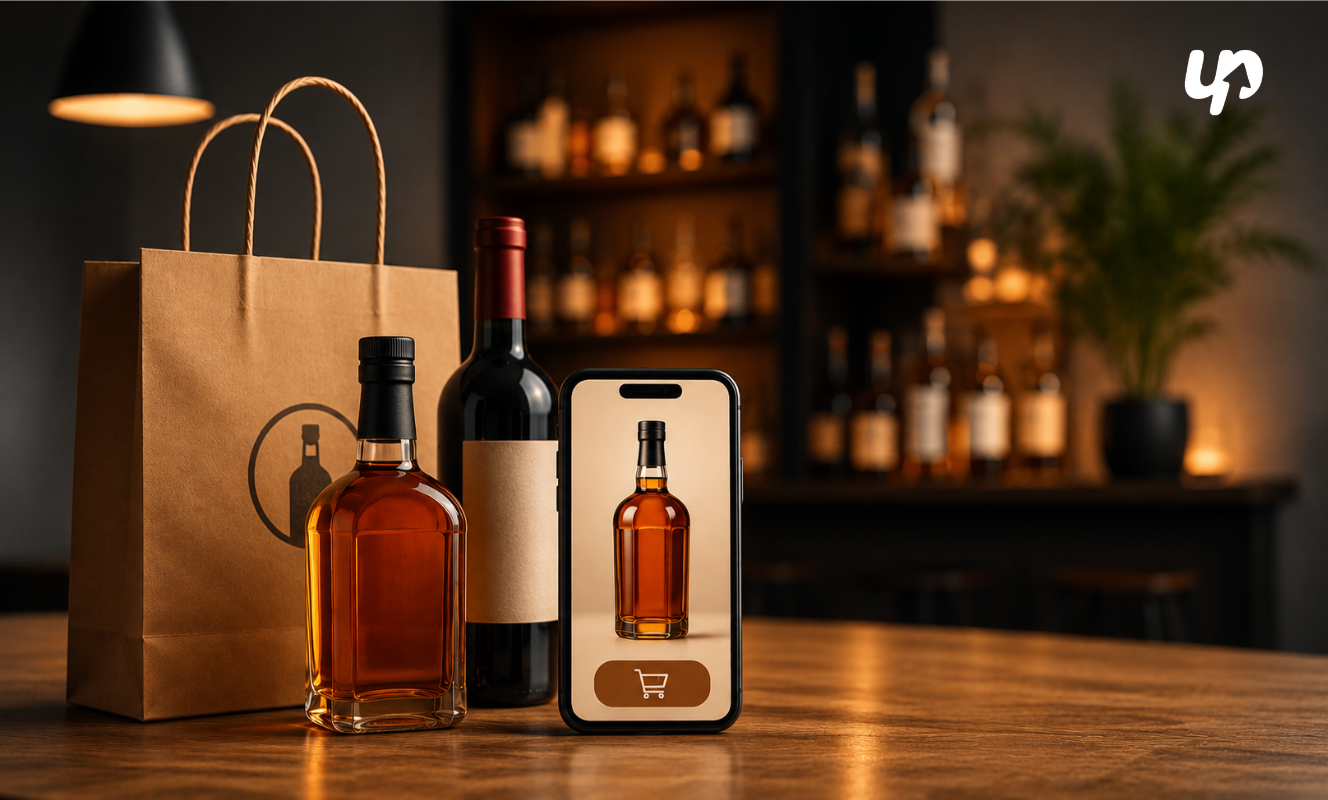
That being said, with a liquor delivery app, a lot is made possible. It can practically help customers pick and choose a drink online, which can then be delivered right at their doorstep. Furthermore, this is legally permitted and compliance-friendly too. This is why such an application offers great value to today’s users.
From the company’s perspective, this means that developing a feature-rich liquor delivery app can be a great opportunity. However, teams working on this development need to consider many aspects.
Some of them include:
- Checking the licensing and permits,
- Ensuring age verification,
- Avoiding location-based issues,
- Ensuring payment security,
- Managing the logistics in real-time, and more.
What’s more, these factors are very important from day one. Thus, many leaders consider hiring application developers to manage their liquor delivery app project.
Following in these footsteps, the first step is to walk through the important considerations for a liquor delivery app development roadmap, including key app features, AI features, development costs, and more. Overall, this guide can help you invest in this idea on a practical scale. So, let’s move into its details right away.
What is a Liquor Delivery App?
An alcohol delivery application, like another AI-driven app, is a digital platform that allows customers to discover alcoholic beverages online. Users can easily check what’s in store, place their orders, make payments, and arrange to either pick up their drink or have it delivered to their doorstep. Overall, it is an app that offers a connected user experience to customers.
From a larger view, many parties work together to ensure each seamless delivery. This largely includes the logistics partners, store management, end-users, and the alcohol delivery app development company.
Thus, it is easy to understand that a well-built liquor delivery app does more than just completing a retail order. In reality, it helps meet user demand for alcohol online, while helping the retailer manage their inventory in real-time. This is why many mobile app development services in the UK are focusing on this segment of development today.
Why is the Concept of On-Demand Liquor Delivery Important in 2026?
Interestingly, a liquor delivery app becoming important is not a conventional demand pattern. It started with the COVID-19 pandemic, and now users are keeping up with their orders, which has originally led to the demand for liquor delivery app development.
Even researchers support this notion. A study by Research and Markets shares that alcohol e-commerce is projected to reach USD 73.92 billion in 2026. Not only that, it may further be valued at USD 161.43 billion by 2032, representing a CAGR of 13.85%.
Thus, there is no doubt that alcohol e-commerce’s growth is just in its inception, and the trend is set to elevate in the years ahead. Now, let us understand the key reasons that made this shift possible.
Simply put, customers can easily order drinks online without having to go to an offline store.
With options like on-demand and same-day delivery, the logistics partners are enabling faster delivery cycles for these orders.
-
Wider Choices and Personalized Recommendations
Users have a ton of options to choose from. Moreover, based on user preferences, the app can also provide personalized recommendations.
-
Supported by digital payments
Most liquor apps support the use of digital wallets and safe payment options that might sometimes not be available at offline stores.
-
Credibility through reviews
Finally, users can try new categories of beverages based on product reviews and feedback from other customers. This gives alcohol ecommerce more credibility as well.
-
Increasing use of smartphones
Last but not least, of course, the use of smartphones has also supported this ecommerce trend significantly, as now people reach out to their phones for almost every purchase they make.
Thus, we can simply say that this shift is fueled by many factors, and companies should definitely invest in the liquor app development project to capitalize on this opportunity. However, they cannot neglect to meet the specific legal and operational requirements that this project works around.
Features That a Business Must Integrate in a Liquor Delivery App
Simply put, a liquor delivery app is an ecosystem where the end users, retailers, admin, and logistics interact with each other. That being said, each member plays a key role in allowing the app to function well so that the alcohol delivery can be completed on time.
That being said, this section focuses on the features that a liquor delivery app must have for each of the mentioned panels so that the said goal is met. For better understanding of the leaders, these features are descriptively mentioned below:
1.Customer Panel
This set of features simply aims to help customers choose their alcoholic beverages and order them online. Primarily, this list includes:
-
User Registration and Secure Login
This aspect allows the user to create an account and register their personal information with the app.
-
Product Search and Smart Filters
Commonly an essential feature, it assists users in finding the products that they need, based on filters like brand, price, type, and more.
-
Product Details and Pricing
This feature offers product-related information, like description, price, and availability, to the users, thereby helping them make informed decisions.
This feature helps the user check and confirm their order before the purchase.
As the name suggests, this feature supports the user to pay digitally in a secure manner.
It essentially uses the customer’s address to check the estimated time for delivery, while also supporting their on-demand orders.
-
Order History and Tracking
This feature complements the location management aspect in terms of order history management and real-time tracking.
Aiming to keep users informed, push notifications offer extended customer support wherever necessary.
This aspect helps customers ask any questions to the support team about an order, payment, or delivery.
Most importantly, drinks are permitted based on age verification, so this feature allows age and identity checks to be done so that the legal laws are met at all times.
2. Admin Panel
The admin panel is the main control centre where the business can check customer activity, store activity, delivery operations, and more to ensure that everything is working out smoothly. Mainly, it includes these features:
Through this dashboard, the admin can check all the ongoing and past records of orders, customer reviews, store activities, deliveries, and more.
Through this aspect, the admin can manage customer accounts and profiles from a single place.
-
Store and vendor management
This feature mainly supports the admin in onboarding, verifying, and keeping track of liquor stores managing the deliveries across the platform.
-
Product and category management
As we know, each store might have different categories of drinks. So, the admin can also look into these product categories and their availability along with their pricing at the stores through this feature.
This feature allows the admin to track orders in real-time. At large, this helps ensure smooth and seamless delivery of liquor to the users.
-
Payment and transaction management
Overall, as the name suggests, this feature helps the liquor delivery app development company manage payment issues and transactions.
-
Delivery partner management
The same goes for managing logistics staff, so this feature is also a must-have for your AI-driven app.
Finally, offers, promotions, analytics, and sales orders can be checked and maintained by the admin by the use of this feature in the liquor delivery platform.
3. Vendor Panel
Jumping to another important panel in this list, the vendor directly manages and fulfils the orders that users make. The app features that are necessary for this purpose are mentioned below:
-
Product Catalogue Management
This feature is mainly set in the app to allow the vendor to easily add, update, organize, and manage their product categories and their description.
-
Sharing Inventory and Price Updates
This feature allows the vendor to update the product availability and its related price updates in real-time.
Furthermore, this feature helps the retailer share order fulfillment updates with the end-user.
There are many people who want to know about the store hours. So, in case of a change, the admin can update the store hours for people to know in advance.
This is another commonly noticed feature where the vendor can update on the liquor delivery app if the product is running short of its demand.
4. Logistics Panel
To develop an alcohol delivery app correctly, there are various features that need to be built-in for the delivery partner as well. These generally include the following:
This feature allows the delivery partners to create an account on the liquor delivery app. This also helps them to complete the necessary verification checks for their job role.
As they are registered with the app, they can now pick orders based on their location and availability.
-
GPS Navigation and Real-time Tracking
Furthermore, this feature helps them to complete the orders using navigation while also sharing their real-time location updates.
The location updates are also logged on the app so that the end-user can see where their order has reached or what its current status is.
When the delivery partner reaches the user’s location, they also have to record evidence that the order has been handed over to the customer. This feature helps confirm this.
Finally, the delivery agent can check their overall earnings, ratings, and performance through this feature on the liquor delivery app.
Advanced AI-Driven Features in a Liquor Delivery App
Other than the essential features we studied, the liquor app can be made better and more intelligent by embedding the following AI-driven features.
-
AI-Powered Product Recommendations
Today, AI systems can record customer behavior patterns, cart updates, and purchases to predict what they might buy next. So, these can be used in real-time to share product recommendations.
ML models can help forecast demand in advance. They can study a huge volume of business data quickly and can guide retailers to plan their inventory accordingly.
-
Intelligent Inventory Management
Based on data-driven intelligence that the AI system relies on, teams can very well identify the items that are selling faster, slower, and the ones that are not selling at all. Accordingly, the business can restock them for the future.
Today, apps have built-in AI bots to manage common customer queries. These can help them answer easy and complex questions, which can also be further routed to human personnel if needed.
-
Delivery & Route Optimization
Last but not least, AI can identify anomalies, fraud, and issues in logistics networks. Based on this, routes can be optimized, and strategies can be improved, which fully affects the app’s performance.
Interestingly, even cybersecurity is smarter with the use of AI today in all applications and platforms. So, a liquor delivery app should make no exception. Thus, the idea is that essential features are where you start building your app, while these advanced features promise excellent, long-term performance.
Step-by-Step Process to Develop an Alcohol Delivery App
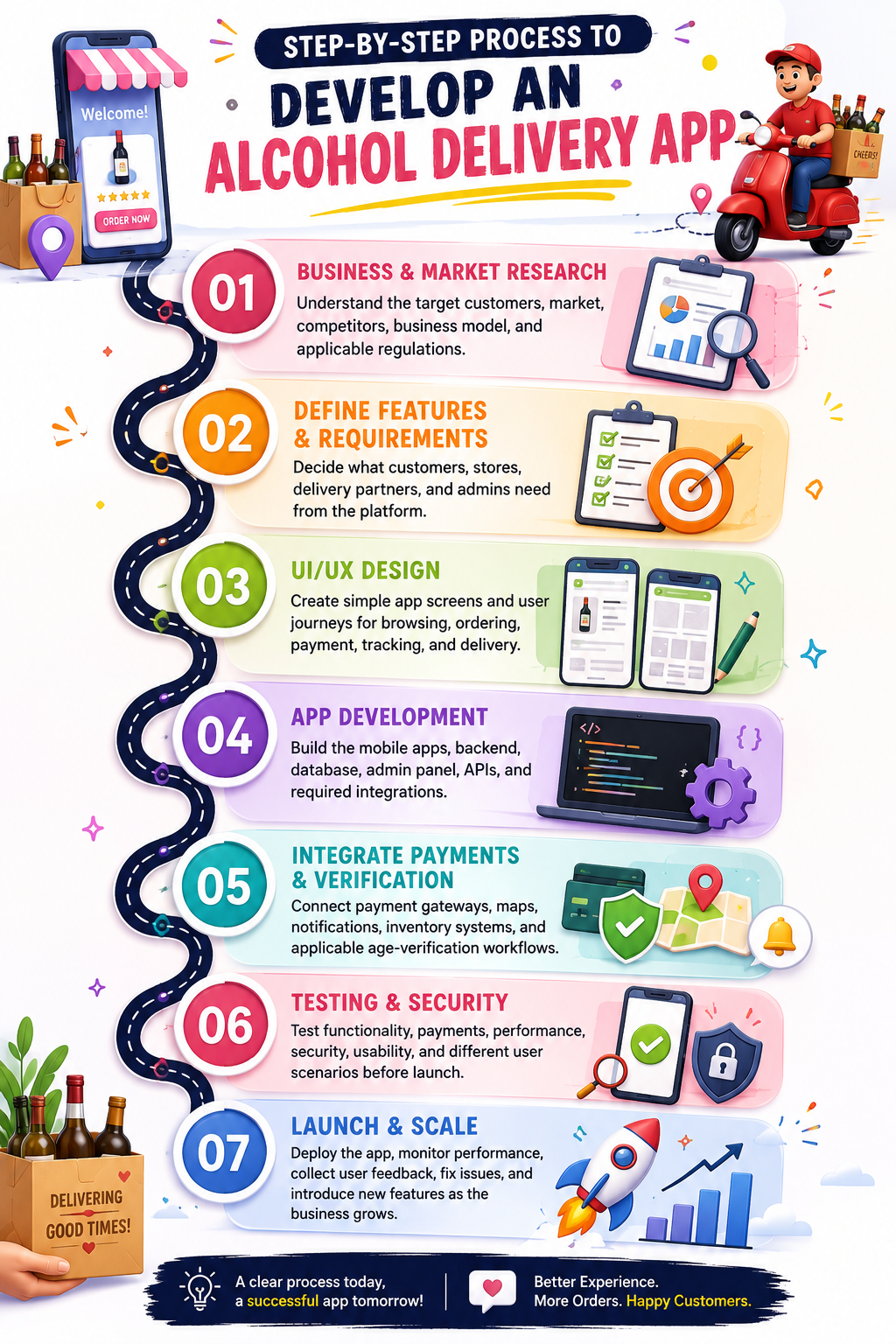
Well, developing a winning alcohol delivery application is not just about sitting and writing code and formulating it into a program. It is rather more complex, as it involves understanding how your app will be a differentiator and what extra value it can provide by integrating intelligence in a balanced manner.
Mainly, in this process, companies will brainstorm around these key stages of the development process shared below:
The Right Tech Stack For Alcohol Delivery App Development
Well, as you progress into exploring technologies that need to be integrated into your modern liquor delivery app, what will become important is understanding which technology will play what role.
While everything will seem important on the surface, it is important to realize that these modern technologies need to work together to build a reliable alcohol delivery app. That being said, here is an understanding of a tech stack that will be helpful in this development.
| Layers of Technology |
Type of Technology |
What It Manages |
| Mobile App |
Flutter, React Native, Swift, Kotlin |
Allows teams to develop the apps’ framework. |
| Frontend |
React.js, Next.js |
Helps build interactive customer-facing interfaces like admin and store management panels. |
| Backend |
Node.js, Python, Java |
Handles business logic, APIs, orders, users, payments, and platform workflows. |
| Database |
PostgreSQL, MySQL, MongoDB |
Stores customer, product, inventory, order, payment, and delivery data. |
| Cloud & Hosting |
AWS, Microsoft Azure, Google Cloud |
Allows scalable architecture for hosting applications. |
| APIs & Integrations |
REST APIs, GraphQL |
Connects the app with payments, maps, and notifications. |
| Payment Gateway |
Stripe, PayPal, Local Payment APIs |
Enables a very secure platform for digital payments and transaction processing. |
| Analytics |
Google Analytics, Firebase, Custom BI |
Helps enterprises to track the pattern of orders. |
| Security |
SSL, TLS, OAuth 2.0, Encryption |
Protects sensitive information, user accounts, transactions, and key business data. |
Overall, these technologies can help the application perform well. Moreover, this choice also depends on what the app is expected to perform in terms of its functionality, security requirements, integrations, and long-term scalability.
Understanding the Cost To Build an Alcohol Delivery App
As teams brainstorm about choosing the right tech stack, the next step in our liquor delivery app development roadmap is to understand its related cost structure.
Generally, this range falls between $3,500 and $50,000+, but it also largely depends on your app’s features, complexity, number of user panels, integrations, design requirements, and scalability needs.
So, we recommend that for a business starting with an MVP, it is best to start with a basic alcohol delivery app and scale later as demand grows. Overall, there are a multitude of factors that will affect your decision, and these can be better understood in the table below:
| Factors Affecting Cost |
Description |
Cost Range |
| MVP App Build |
Focus on core features for checking functionality. |
$3,500–$8,00 |
| Standard App Development |
Standard features like inventory management, GPS, order tracking, and more. |
$8,000–$20,000 |
| Advanced App Build |
Features like real-time inventory, advanced logistics, and multiple payment options. |
$20,000–$50,000+ |
| UI/UX Design |
Wireframes, prototypes, and custom interfaces. |
$500-$4000 |
| AI & Automation |
Features like recommendations, demand forecasting, and predictive analytics. |
$1,500–$10,000+ |
| Testing & Security |
Focuses on cloud hosting, deployment, security updates, bug fixes, and ongoing improvements. |
$500–$4000 |
Overall, this analysis can be helpful in allowing teams to determine a final quote for their project. Furthermore, the features that you choose, i.e., security, monitoring, infrastructure, and other key aspects, also help in influencing this range.
Final Thoughts
Thus, building a successful liquor delivery app is a real opportunity for enterprises today. Undoubtedly, there is a lot for teams to work on, but the return is quite fruitful, given the projected hike in the growth of the e-commerce alcohol industry.
Overall, we recommend that teams consult and hire Android application developers to manage this project and don’t skip AI features and updates, as they bring together a very reliable and safe platform as a whole. Not only will this make your app market-ready, but it will also be promising and highly performing.
Lastly, give extra thought to how licensing and compliance will be managed, as these are non-negotiable as the platform launches, interacts with customers, and grows. Thus, by building all these aspects into the app, teams can capitalize on this market trend in 2026.
 16+ Years of Tech Mastery
Transforming Ideas into Market Ready Platforms |
16+ Years of Tech Mastery
Transforming Ideas into Market Ready Platforms |