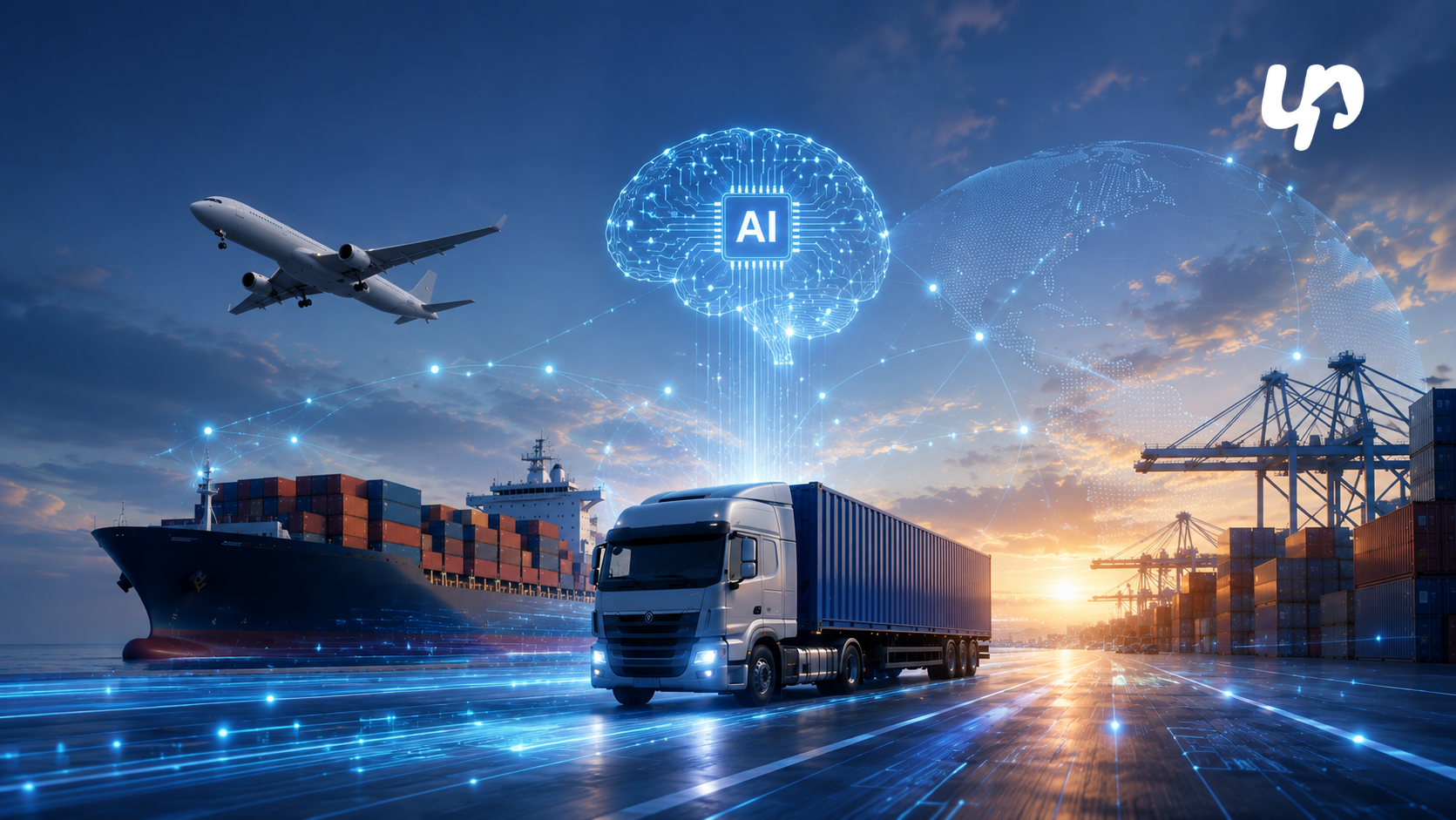
Why Businesses Build Custom Logistics Management Software with AI
To build a custom logistics management software entails the development of a platform that is purpose-built to automate the tasks of route planning, freight tracking, warehousing, and delivery scheduling through the application of machine learning and real-time data, thus phasing out legacy off-the-shelf logistics software that has failed to keep pace with the ever-increasing complexity of modern supply chains. A growing number of manufacturers, retailers, e-commerce businesses, and healthcare firms are opting for custom built logistics software because generic logistics software are too rigid to efficiently manage the dynamics of constantly fluctuating demand, multi-carrier networks, and customer delivery requirements.
The companies that are outpacing their competitors are not the ones that share a platform with all others but rather the ones that have made a strategic investment in a tailor-made AI-powered logistics solution that is tailored to their own specific needs-the carrier contracts they use, the layout of their warehouse facilities, the promises they make to their customers. In this guide, we explain what bespoke logistics management software is, the features that should be included in such software, the impact of artificial intelligence on logistics performance, and the approximate cost to implement it.
Market Overview- AI Logistics Software Development in 2026
The global logistics software market was worth over 14 billion dollars in 2024 and is expected to grow by over 10% annually between 2024-2030. This growth is not a function of incremental digitisation; it is structural change to how supply chains are run. Manual coordination, static route planning and reactionary exception management are being replaced by AI logistics software development that uses real time data, learns from operational patterns and makes better, faster decisions than any team can.
E-commerce growth is the single biggest driver. The increase in the number of parcels being shipped and reduction of customer expectations on delivery times from days to hours has stressed logistics infrastructure supporting retail and distribution operations to levels for which they were never designed. Those firms who relied on off the shelf logistics software are learning that this software was developed for “average” operations, not competitive operations. This space between what generic software can provide and what is demanded in the market is where custom logistics management software development has shifted from a luxury to a necessity.
The use of AI in logistics is now moving beyond enterprises. Mid-market freight operators, regional last-mile delivery firms and D2C operations managing their own fulfilment, are all in the process of developing or commissioning custom logistics software platforms. The cost of developing AI/ML systems has fallen significantly, the cloud infrastructure to deploy a system for any size operation is readily available, and the return on investment (fuel efficiency savings, reduced undelivered parcels, decreased personnel to parcel ratio) is well documented across various industries.
On the technology side, the maturity of LLMs, computer vision and advanced analytical frameworks means the technology is now mature and not experimental, giving us well-proven building blocks for logistics app development and AI software in 2026. Businesses who are investing in this space now are not betting on immature technology, they are implementing capabilities that their most efficient competitors are already leveraging.
A logistics software development firm must understand both aspects of the equation: the realities of running a logistics operation and the technical sophistication needed to build the AI system that performs under operational loads. Software that works on a demo account and fails on a peak volume Tuesday is not a solution. This is the differentiator between genuinely developing an on-demand logistics app and generalist software houses that have expanded into this space.
What Is Custom Logistics Management Software?
A bespoke logistics management software is a system designed from the ground up around the operational realities of a specific logistics business- not simply a standard, off-the-shelf solution made to fit “average” operations.
While out-of-the-box logistics systems force you to accommodate your operations to fit the software, bespoke systems are custom-built to accommodate your operations. Your carrier relationships, your warehouse structure, your client SLAs, your exceptional processes, your reporting needs, everything you need the system to do is built in as a priority, instead of being accommodated later.
Once you add AI into a bespoke system like that, the system not only reflects your operations but continuously optimizes them. It will leverage your past data to find patterns that your staff can’t identify in the real world at scale, while identifying or suggesting opportunities that decrease cost and improve dependability.
Core Features to Include When You Build Custom Logistics Management Software
The right featureset is discovered, not prescribed by a checklist; however, custom logistics management software platforms that have been successful over time have been consistently architected around these core features:-
1. AI-Powered Route Optimization
Dynamic, real-time routing that factors in traffic, weather, vehicle capacity, delivery windows and fuel cost at the same time, not at the beginning of the day, but continuously as conditions evolve.
2. Real-Time Shipment Tracking
End-to-end visibility across all carriers and all fulfillment nodes that provides event-driven updates to both operational and customer teams.
3. Predictive Demand Forecasting
ML models trained on order history, seasonality, and external factors that anticipate demand and improve inventory positioning to minimize stock-outs and carrying costs.
4. Automated Warehouse Management
Software controls for slot allocation, pick path optimization, inbound processing and dispatch coordination rather than manual coordination.
5. Fleet Management and Predictive Maintenance
Real-time IoT enabled monitoring of vehicles to enable maintenance based on the actual condition of the asset as opposed to pre-scheduled maintenance intervals.
6. Multi-Carrier Integration
A common API layer for all of the global and regional carriers enabling comparisons, booking, and label creation within one interface.
7. Customer Facing Delivery Portal
Branded delivery status and notification portal that decreases inbound support inquiries while improving post-purchase experience.
8. Analytics andOperations Dashboard
Operational dashboards tracking cost per delivery, SLA compliance, exceptions, and other KPIs built around how your operations teams work.
The business case for AI in logistics is not just theory any longer. Companies using AI-powered logistics solutions are experiencing consistent, demonstrable gains across all the major cost centers of the logistics business.
AI route optimization lowers fuel use and improves on-time delivery by finding the optimal balance between dynamically changing variables- like current traffic, available driver time, vehicle capacities, and required delivery times- a feat beyond the scope of any static routing solution in real-time at scale. And the improvements get more profound: the more delivery data the AI system processes the more precisely it optimizes.
AI demand forecasting lowers both excess inventory holding costs and stockouts by learning individual order patterns, promotions, and external demand drivers to deliver accuracy far superior to manual planning or spreadsheet models.
Automated exception management identifies shipments that are likely to miss the deadline or breach an SLA, or where capacity is limited, and resolves or escalates them without human involvement for every individual exception event, lowering headcount for a given shipment volume.
The compound benefit is a critical consideration to a logistics business.
By 2028 a company that adopts the AI platform in 2026 has already built two to four years of operational learning into its system. A company delaying its investment does not. In a thin margin, service-driven market this lag is material.
How Much Does Custom Logistics Software Development Cost?
| Feature |
Estimated Cost (USD) |
| Discovery Phase & Product Architecture |
$3,000 – $8,000 |
| Cloud-Native Backend (Scalable Infrastructure) |
$8,000 – $20,000 |
| User Authentication & Role Management |
$3,000 – $7,000 |
| AI Route Optimization Engine |
$15,000 – $40,000 |
| Predictive Demand Forecasting (ML) |
$20,000 – $60,000 |
| Automated Exception Management (AI) |
$12,000 – $30,000 |
| Real-Time Shipment Tracking |
$10,000 – $25,000 |
| Customer-Facing Delivery Portal |
$8,000 – $18,000 |
| Fleet Management & IoT Integration |
$15,000 – $35,000 |
| Multi-Carrier API Integration |
$10,000 – $28,000 |
| ERP / WMS System Integration |
$12,000 – $35,000 |
| Payment Gateway Integration |
$5,000 – $15,000 |
| Warehouse Management Module |
$18,000 – $50,000 |
| Analytics & KPI Dashboard |
$8,000 – $22,000 |
| Admin CMS & Configuration Panel |
$6,000 – $15,000 |
| Driver Mobile App (iOS + Android) |
$12,000 – $30,000 |
| Push Notifications & Alerts |
$3,000 – $8,000 |
| Post-Launch Support & Maintenance (12 months) |
$8,000 – $24,000/yr |
Full platform range: $15,000- $350,000+ Typical business platform: $60,000- $180,000
Final pricing will only be available once the discovery stage is complete. The key drivers for cost will be; feature breadth, complexity of the AI/ML, the number of third party integrations and the depth of those integrations. A business commissioning a simple tracking and route optimization core platform will sit far different on the spectrum than one building a fully AI-driven warehouse, fleet, and fulfillment system.
How Fluper Helps You Build Smarter Logistics Software
Fluper is a logistics software development company built for those who require an AI powered system to run under real world operating conditions rather than a proof of concept build that will break under shipment velocity or a down third party integration.
Each Fluper engagement begins with an architecturally driven discovery phase, removing scope uncertainty prior to development commencement. Architectural decisions are determined by the client’s true data load, system integrations, and future scalability needs. AI & ML components are defined and confirmed during discovery rather than being introduced as after-market solutions post-completion.
Support, OS maintainability, and feature road mapping are confirmed prior to go live rather than discussed in the midst of a crisis six months post launch. Fluper has provided customized logistics software across freight forwarding, last mile, cold chain, field service and warehouse operations throughout the world.
FAQs
- What does custom logistics management software with AI mean?
It means we build your logistics system from scratch (not adapt a general purpose tool) with embedded AI functionalities for such tasks as routes planning and optimizing, forecasting demands or automatic exception management. The system will fit the business processes and improve its accuracy with the increase of input operational data.
- How much time does logistics app development take?
A core custom logistics management software platform (tracking, route optimization, carrier integration) from discovery to live application takes 4-8 months on average. A fully-integrated AI/ML pipeline, WMS and multi-regional deployment platform usually take from 10 to 18 months. The timeframe depends mainly on the efficiency and depth of the discovery stage.
- What is the difference between custom and off-the-shelf logistics software?
Off-the-shelf applications are designed for the “average use case” and your operations must conform to the software. Custom logistics management software development is built around your unique business process, carrier network, customer commitment-everything to fit into your operations rather than bending them.
- Can I add AI to the existing logistics platform?
Possibly, if your current system is equipped with a proper API layer and data structures. However, most of the legacy systems are not ready for event-driven data processing which is necessary for AI integration. Our tech audit in the discovery stage will show you the most economical decision: direct integration or phased replacement with a new system.
- Why should I choose Fluper for logistics software development?
Fluper specializes in AI logistics software development for enterprises that run at large scale. The efficient discovery process, robust architecture for operational workloads, and experience with freight, last-mile and warehouse industries make our customers achieve actual productive systems, not just demos.
 16+ Years of Tech Mastery
Transforming Ideas into Market Ready Platforms |
16+ Years of Tech Mastery
Transforming Ideas into Market Ready Platforms |