Introduction
Most companies which have launched a mobile app between 2018 and 2023, actually have a working application. It solves a problem, it meets the needs of the user to some extent, and it does what it’s supposed to do. The problem, however, is that what worked in 2026 will not suffice to be competitive in 2026. These two concepts grow ever further apart quicker than the average product team might have expected.
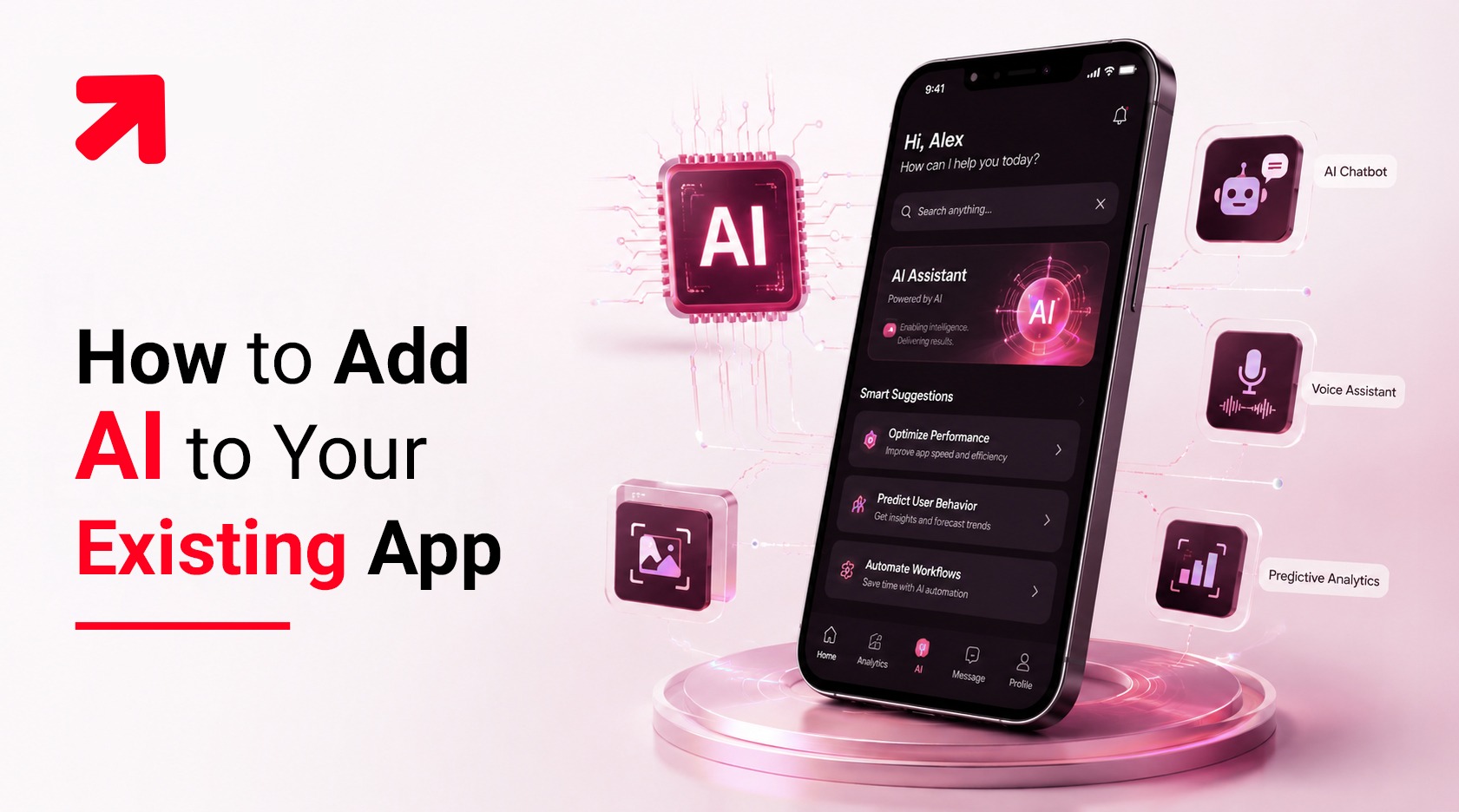
The gap continues to grow, mainly due to integration of Artificial Intelligence into mobile applications. Businesses which are adding AI to their current products i.e. Personalisation, conversation agents, predictions based on user behaviour or automating workflow processes not only enhance the users experience but they create a compound increase in retention and engagement which is soon to be beyond non-AI product reach.
What we need to have in mind is what Artificial Intelligence can add to the current products, how we plan to achieve it and either to possess it internally or find the resource for it. These steps will help with just that.
Market Overview- AI Integration in Mobile Apps 2026
The market for mobile app development and AI has been rapidly expanding, from a niche technical skill just two to three years ago to a core element in product development. The market’s investment into mobile applications has increased significantly over all other software industry branches, thanks to the accessibility of language models, computer vision, and cloud-based machine learning resources which minimize the development effort of non-AI specialists. The companies that are succeeding the most are not remodeling their entire application to use AI; rather, they are implementing specific integration projects to improve their applications with AI while keeping the existing core structure which users are familiar with.
In 2026, this type of integration-led approach will be what clearly separates a highly successful app from an expensive and long redevelopment.
There has been an explosion in the availability of AI-integrated app development companies, and in the last 2 years, these services have been made available for all small and medium enterprises, not just large organizations. It not only offers app development services for entirely new apps, but also for redeveloping an existing app with AI features at an affordable cost.
Why Adding AI to Your Existing App Makes Business Sense
- User Retention: Perhaps the most compelling business advantage of AI in mobile apps, AI helps you retain users by tailoring features such as content or products to match their specific needs. For monthly active user-driven mobile apps, there is arguably no better financial investment possible.
- Operational Costs Savings: Beyond the user’s benefits, AI offers benefits such as automating customer support interactions, improved document processing, and enabling predictive field service. Savings from efficiency gains will often recuperate an initial investment within 12-18 months.
- Competitive Positioning: In any vertical market with several companies offering essentially the same core features or services, the fact that mobile apps have incorporated AI has quickly become a leading factor in the purchasing decision. This has been notably true in B2B industries in the last 2 years where AI integration has become a core element of tender processes in government and large corporation purchasing procedures.
Type of AI integration for a pre-existing mobile application
1. Natural Language Processing and Conversational AI
Incorporating a conversational interface in the existing mobile application is by far the easiest way to integrate artificial intelligence into the existing system. Integrating language models using APIs from companies such as OpenAI, Google or Anthropic will empower your users with an interface which they are now accustomed to, and they will no longer need to interact with the current app in a way they are not used to.
2. Personalisation and Recommendation Engines
One of the longest tested and most successful applications of artificial intelligence in mobile apps are recommendation systems that adapt to user preferences and present them with new relevant features, content or products. This type of system, if successfully integrated into an existing mobile app, will impact the engagement levels of users within a matter of weeks without changing any aspect of your existing app architecture.
3. Computer Vision
Any mobile application that relies heavily on visual elements, such as retail or field service apps, will now be able to integrate easily with computer vision technology using new and existing APIs. Integrating visual searches or object identification directly into an application should not be an obstacle anymore even if there is limited to no previous machine learning expertise or resource within the company.
Step-by-Step Process to Add AI to Your Existing App
Step 1- Audit Your Current App and Data
The first step to integrating artificial intelligence into your application, or to start any app development for it is to understand precisely what your starting point is. Map out the various user flows on your application and where precisely intelligence could have the most positive effect on user engagement by streamlining, personalizing or automating aspects of the experience.
Additionally, audit the type and amount of data that you have available; these applications often require training data to work and so data will have an impact on how a product is integrated and to what capacity.
Step 2- Define the Use Case With Precision
Poor briefs will generate poor AI integration so you must understand precisely what you intend artificial intelligence to deliver. Rather than focusing on adding the technology to an app in a general sense, define precisely what you want the application to do, for example delivering a personalization system that enhances average session time by twenty percent or automated support features that result in sixty percent of lower priority support requests being resolved without human intervention are both specific and measurable examples of achievable results from an integration led strategy.
Step 3- Choose Your Integration Approach
There are three different general methods for integrating AI into your mobile app and these have varying development timelines, cost impacts and degrees of technical complexity involved.
API-led integration which connects your application to an external artificial intelligence service, is usually the most expedient and accessible way to achieve your goals and this can then be augmented by custom model development for any aspect of your product that is highly specialized, at an additional cost. Hybrid approaches also exist that use both off the shelf AI products as well as bespoke components for particular functions.
Step 4- Build, Test and Iterate
Adding AI features to an existing product requires an iterative approach. Create a minimal viable AI feature, test it on a small segment of your users, track the performance relative to your defined metric and iterate. It’s only after iterating with this user feedback loop that you should roll out your AI features on full scale; AI features released without this loop tend to under-perform because of their inability to account for real user behaviour, not technology issues.
Step 5- Continuously Monitor
AI models will naturally degrade over time because the real-world data to which they are exposed will start to drift from the training data set. Include ongoing monitoring and retraining into your operational model from the very start instead of approaching AI integration as a one-time deployment.
The Challenges and the Solutions
1. Data Volume and Quality
The biggest reason AI integration fail is having insufficient/bad training data. If you are not already systematically gathering and cataloguing structured user behaviour, that should be your priority prior to any model training. This involves the appropriate instrumenting of your application and collecting event data for some duration before the AI integration process commences.
2. Legacy Architecture Complexities
Existing legacy codebases can pose very real integration challenges. It’s usually more feasible to build the AI piece as a distinct service with a well defined API boundary with which it can communicate with an existing product, than to embed the AI code into the legacy application code. This preserves the existing product stability and also makes the AI features independently manageable.
3. User Trust and Transparency
It is becoming ever more obvious that end users know when a product has used AI to either suggest or determine elements within their user experience. The clear expectations are that these elements should be clearly identifiable as AI-generated and that the user should have a mechanism for submitting feedback on the AI. Companies with secretive AI integrations often face increasing resistance.
Choosing the Right AI App Development Company
A large market for AI app development company services has been emerging recently. However this market has significant variability of quality. The critical criteria are: existing experience adding AI to products rather than native AI products, methodology regarding discovery and scoping, and post-integration support.
A company that will push back on vague project requirements, ask hard questions of your data, and recommend an iterative development approach rather than providing you with an exact quotation upfront, are likely doing these projects at a professional level. Ask potential vendors for references from past clients they have worked with for production AI integration into existing products rather than purely net new AI products.
Why Businesses Choose Fluper for AI App Integration
As AI becomes a defining factor in mobile app success in 2026, businesses need a development partner that understands both modern AI capabilities and existing application architecture. Fluper helps companies integrate AI into their current mobile apps without requiring a complete rebuild. From conversational AI and recommendation engines to predictive analytics and workflow automation, Fluper delivers scalable AI integration solutions tailored to business goals. Their expertise in API-based AI implementation, cloud infrastructure and cross-platform app development enables startups and enterprises to modernize existing products faster, reduce operational costs and improve user engagement while maintaining application stability and performance.
Frequently Asked Questions
Q1. How much does it cost to add AI to an existing app?
A standard API based integration of a conversational chatbot or recommender system will range between fifteen thousand to fifty thousand dollars whereas a completely new AI model development for specific proprietary purpose will range from fifty thousand to two hundred thousand dollars and above. Additionally, one should plan for 2k to 10k monthly operational expenses.
Q2. How long does AI integration take?
An API based integration that has been properly scoped will take between six to twelve weeks and a custom AI model development could take three to six months depending on model complexity.
Q3. Do I need to rebuild my app to add AI? You should not need to rebuild your entire application, you can always have the AI developed as a standalone application or API layer.
Q4. What data do I need to add AI?
You need historically collected user behavioural data for recommendation systems, example query-response data for conversational agents and historical decision making data for predictive models. Your developer should guide you on exact data required.
Q5. Which are the most useful AI features to add to an existing product first? Conversational search, content or product personalization and targeted notifications often deliver clear, measurable results and are easiest to integrate for companies adding AI to an existing application for the first time.
Q6. How do I know if an AI integration is successful?
Define and measure metrics before integration, this could be session length, customer retention, click-through rate on recommended items or decreased ticket deflection rate, all of which show that the added AI capability has the desired effect.
 16+ Years of Tech Mastery
Transforming Ideas into Market Ready Platforms |
16+ Years of Tech Mastery
Transforming Ideas into Market Ready Platforms |